Managers: Prevent Back Pay Risk with Multi Location Time Tracking

The fastest reliable fix for multi-location teams is a location-aware time clock that pairs GPS or geofence verification, quick site selection, real-time sync, audit logs, and clear travel-time policies. The compliance anchor is simple: employers must pay for every hour they know or should reasonably know was worked, a standard DOL guide on teleworking hours spells out directly. The rest of this guide walks through the implementation details and a workable pilot plan.
TL;DR:
- Using a location-aware time clock with GPS or geofencing ensures accurate, real-time tracking for multi-site teams, but offline punches must be timestamped locally and synced later.
- Soft geofences are suitable for outdoor or imprecise boundaries, while hard geofences are best for fixed locations; pairing GPS with photo verification helps resolve disputes quickly.
- Employers must pay for all hours they know or should reasonably know were worked, making clear travel and site change reporting procedures essential for compliance.
- Consistent application of monitoring rules, transparent policies, and documentation reduce discrimination risks and build employee trust in multi-location tracking systems.
- A phased pilot with sites configured and tested individually improves accuracy before full rollout, and choosing a system with audit logs, approval workflows, and off-site support simplifies management.
Table of Contents
- How location-based clock-ins should work
- GPS verification and geofencing: capabilities, limits, and privacy considerations
- Travel time and compensable hours: how to record and comply with FLSA guidance
- Real-time sync, approvals, and audit trails for multi-location visibility
- Rules, policies, and training to make multi-location tracking reliable
- Common failure modes and how to prevent them
- How Kloqk helps with multi-location time tracking
- Implementation checklist and vendor evaluation criteria
- Author Saad’s perspective: balancing enforcement and trust for mobile teams
- Pilot Kloqk across your locations
- Sources
- FAQ
How location-based clock-ins should work
Clock-in design decides whether multi-site tracking actually gets used correctly. Staff moving between sites need a system that is fast enough not to cause a line at the door, but structured enough to produce clean records for payroll.

Most setups blend auto-detection with manual confirmation. The app can detect a likely site from GPS and prompt the employee to confirm it, rather than silently guessing. Job codes or site drop-downs work well when an employee splits a shift across two locations in one day, since the record then shows which hours belong to which site.
Kiosk and mobile options serve different situations. A shared kiosk with NFC badges suits a single busy location such as a restaurant floor or a warehouse dock, where several people clock in within minutes of each other. Mobile clock-ins suit field staff and multi-site roles where no shared device exists.
Connectivity gaps are common on job sites and in rural areas, so the app should cache a punch locally and sync it once a signal returns, timestamped at the moment it happened rather than when it uploads.
- Use auto-detect with a confirmation step rather than a fully manual site pick, which slows down busy shift starts.
- Reserve kiosks for single, high-traffic sites and mobile punches for field or multi-site staff.
- Require offline punches to retain their original timestamp, then flag them for a quick manager review once synced.
GPS verification and geofencing: capabilities, limits, and privacy considerations
A geofence can work two ways: a soft check that flags a punch outside the expected radius for manager review, or a hard block that prevents the clock-in entirely until the employee is inside the zone. Soft checks suit field teams with imprecise site boundaries, such as landscaping crews working across a property line. Hard geofences suit fixed locations like a retail store or clinic where the boundary is unambiguous.
GPS has real limits. Signal drift near tall buildings, weak accuracy indoors, and the technical possibility of location spoofing all mean a single GPS point is evidence, not proof. Pairing a geofence with photo verification at clock-in gives a manager two data points to check instead of one, which matters when an exception report needs resolving quickly.
- Use a soft geofence alert for mobile or outdoor work with uncertain boundaries.
- Use a hard geofence block for fixed single-address locations.
- Pair GPS with photo verification when disputes or theft risk are a concern.
- Route unresolved location exceptions to a manager queue instead of auto-approving them.
The EEOC has cautioned that location monitoring can create discrimination risk if applied inconsistently, warning that selective use of wearables or location tracking on only certain employees can amount to an EEO violation (EEOC fact sheet on wearables). The practical takeaway is to apply the same geofence and verification rules to every employee in a comparable role, document why the monitoring exists, and keep that documentation on file alongside your written policy.
Travel time and compensable hours: how to record and comply with FLSA guidance
Travel rules trip up more managers than any other part of multi-location tracking, mostly because the line between a commute and paid work is not obvious. Ordinary commuting to a regular worksite is generally not compensable, but travel between job sites during the workday is worktime that must be counted (DOL hours worked guidance). A technician who drives from a morning job to an afternoon job is on the clock for that drive.
The employer’s knowledge standard matters just as much as the travel rule itself. Employers must pay for hours they know or have reason to believe were worked, and reasonable diligence through a clear reporting procedure helps establish what the employer should have known, particularly for remote or teleworking staff (DOL Field Assistance Bulletin 2020-5). A system that makes it easy to report an unscheduled site visit protects both the employee’s pay and the employer from a later wage claim.
Three operational rules turn this guidance into something a manager can actually run:
- Publish a simple reporting procedure for any travel, site change, or extra stop that is not already in the schedule.
- Capture job-to-job travel as its own line item rather than folding it into the destination site’s hours.
- Set a rounding policy, if one is used, that stays consistent across every site and matches what the timecard actually shows.
Recordkeeping closes the loop. The DOL’s recordkeeping fact sheet calls for payroll records to be kept for at least three years, with records supporting wage computations, including timecards, generally kept for two years (DOL Fact Sheet #21). Any timekeeping method is acceptable to the DOL as long as it produces complete and accurate records, which means a digital export with timestamps, edits, and approvals in one file is often easier to defend than a stack of paper slips. For field-service businesses tracking job-to-job travel specifically, a dedicated look at dispatch time tracking covers the scheduling side in more detail.
Real-time sync, approvals, and audit trails for multi-location visibility
A manager running three or ten locations cannot review payroll accurately if site data trickles in a day late. Real-time sync means a punch at any location shows up on the central dashboard within minutes, which lets a manager catch a missed clock-out before it becomes a payroll dispute instead of after.
Conflict handling matters when the same employee clocks in from two devices, or when an offline punch syncs after a manager has already approved the week. The system should flag the conflict rather than silently picking one record.
An audit trail earns its name only when it records more than the final number:
- The original punch time and location, unedited.
- Who made any edit, with a timestamp for the change itself.
- A reason code or note attached to every edit.
- Any supporting evidence, such as a GPS point or a photo, tied to that punch.
Approval workflows should run on a short cycle, typically a weekly window, with exceptions escalated automatically if a manager has not acted within a set number of days. Locking payroll periods after approval, with edits afterward requiring a separate correction entry, keeps the audit trail clean and protects the business if a wage claim surfaces later. A closer look at monitoring remote clock-ins covers approval cadence and exception handling in more depth.
Rules, policies, and training to make multi-location tracking reliable
Software enforces a policy, it does not write one. Managers need a short, written document covering clock-in rules per site, which devices are approved, how travel gets reported, how exceptions are handled, and what happens when someone repeatedly ignores the process.
Training works best in three passes: an onboarding walkthrough when someone joins or transfers to a new site, a brief refresher each time a policy changes, and specific coaching for managers on how to review and approve edits without rubber-stamping them.
- Write one policy document covering clock-in method, device rules, travel reporting, and exceptions.
- Train new hires on the clock-in process during onboarding, not as an afterthought in week three.
- Give managers a short checklist for reviewing edits before approval, not just a button to click.
- Revisit the policy whenever a new site opens or a schedule pattern changes.
Pro Tip: Post the clock-in policy at every physical site, not just in an employee handbook nobody reopens after week one.
A short roll-out checklist, covering device setup, site mapping, a test punch at each location, and a manager sign-off before go-live, catches most configuration mistakes before they touch a real paycheck.

Common failure modes and how to prevent them
Most multi-location tracking problems repeat across businesses, and most have a direct fix.
- GPS drift or spoofing: require photo verification alongside location, set a reasonable distance threshold for flags, and run a weekly exception report rather than trusting the system blindly.
- Inconsistent site naming: keep one canonical list of site names and addresses, and map every device or kiosk to that list instead of letting staff type a location freehand.
- Off-the-clock work going unrecorded: publish a simple reporting procedure for unscheduled hours, remind managers to ask about it during check-ins, and sample a handful of timecards each pay period for gaps.
Each of these is a process fix more than a technology fix. The software catches the exception, but a manager closing the loop is what actually prevents the lost hour or the compliance gap.
How Kloqk helps with multi-location time tracking
A free time tracking plan can include GPS geofencing, photo verification at clock-in, and payroll-ready exports, enabling accurate tracking across sites without requiring a paid tier. Overtime and break calculations run automatically, which matters once a business has more than one site generating separate timecards that still need to reconcile into one payroll run.
A workable pilot runs in three steps:
- Configure each site with its address and geofence radius, then confirm the boundary with a test punch from a phone at the actual location.
- Run a two-week pilot at one or two sites, reviewing the exception report daily rather than waiting until payroll.
- Review the payroll export at the end of the pilot, adjust geofence radii or site names as needed, and expand to the rest of the locations.
The GPS time clock features and remote tracking tools behind this pilot are built for exactly this kind of staged rollout.
Implementation checklist and vendor evaluation criteria
Choosing a time tracking system for multiple sites comes down to three checklists, not a single feature list.
Capability checklist:
- Multi-site support with per-location site selection, not a single generic clock-in button.
- Geofencing with both soft and hard options, plus offline punch caching.
- Audit logs covering every edit, and payroll exports in a format your payroll provider accepts.
- Manager approval workflows with escalation for overdue reviews.
Commercial checklist:
- Pricing structure, whether per user or per location, and whether a free tier or trial exists before committing.
- Onboarding support for mapping multiple sites correctly on day one.
- A clear data export policy so records are usable outside the platform if needed.
Security and privacy checklist:
- A stated retention period for location and punch data.
- Role-based access so only the right managers can view or edit records at a given site.
- A documented privacy policy covering how location data is collected and used.
Author Saad’s perspective: balancing enforcement and trust for mobile teams
Most multi-location time tracking failures are not technology failures, they are trust failures. A geofence that silently blocks a clock-in without explanation breeds resentment faster than it prevents fraud. Employees comply more readily with a system when the reporting path is easy and the rules are visible, not hidden in a policy nobody read.
The same applies to monitoring itself. Document every exception, apply the same geofence and verification rules to everyone in a comparable role, and resist the instinct to tighten enforcement only after one bad incident. Consistency is what keeps a time clock a management tool instead of a liability.
Saad
Pilot Kloqk across your locations
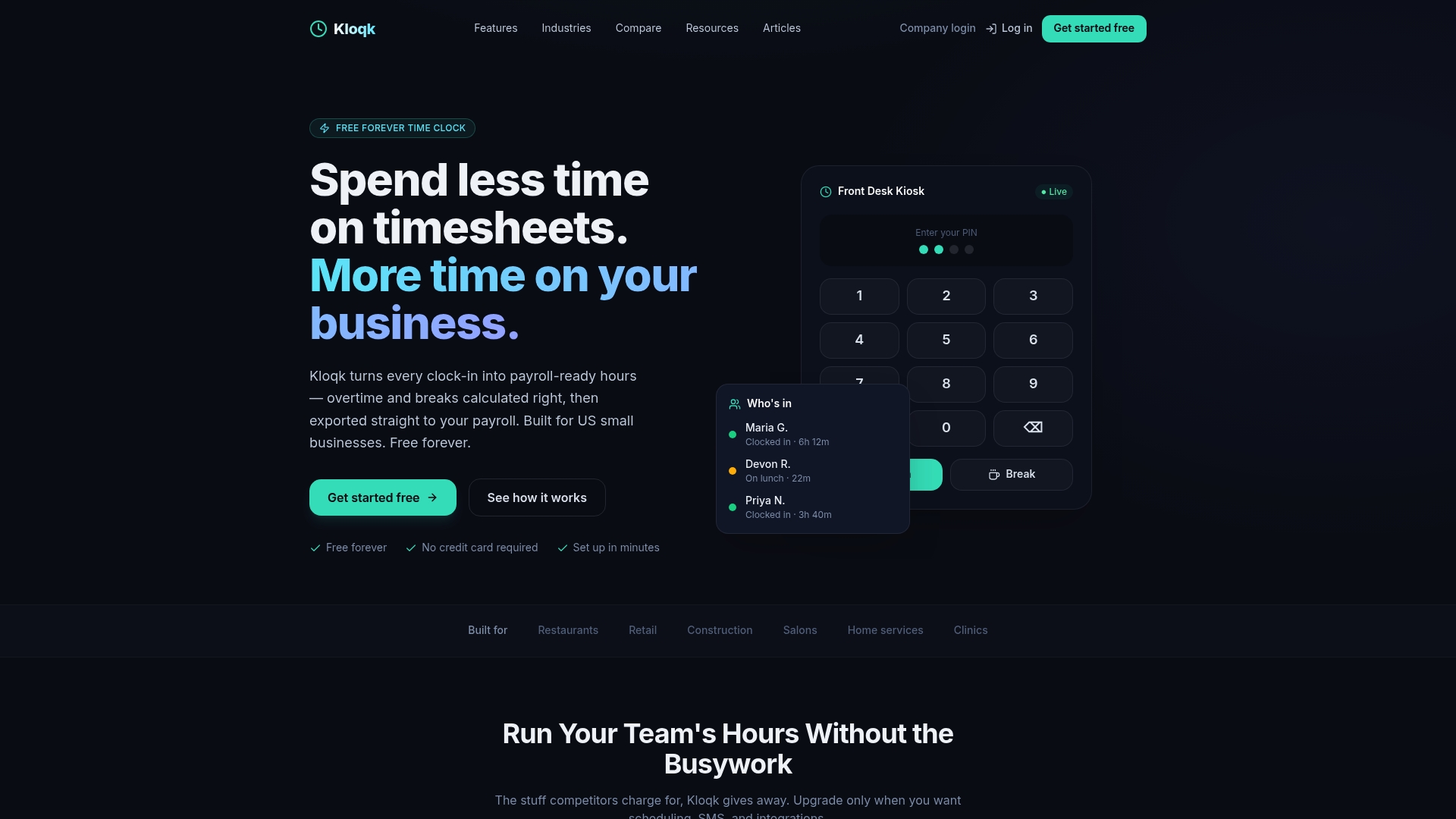
Running payroll across several sites without a central system usually means someone is calculating overtime by hand at month end. A free plan that includes GPS geofencing, photo verification, and payroll-ready exports for every location without a per-user fee allows small businesses with multiple sites to get clean records from day one.
- Configure your sites and geofence radii first, then confirm each with a test punch.
- Run a short pilot at one or two locations and review the exception report daily.
- Check the plans and pricing when you are ready to add scheduling or PTO tools.
Start with the free tier and see what your payroll export looks like after one real pay period.
Sources
This article is general information, not a substitute for advice from a qualified lawyer. Consult a qualified legal professional about your own circumstances before acting on anything here.
FAQ
What is the best geolocation time clock app?
There is no single app that fits every business, but a strong fit for multi-location teams combines GPS or geofence verification, offline punch caching, and payroll-ready exports. Free options such as Kloqk’s GPS time clock include geofencing and photo verification without a per-user charge, which is worth checking against any paid alternative.
What is the best time tracking app for multiple projects?
Look for an app that lets employees tag hours to a job code or project at clock-in, not just a location, so one shift can be split across tasks accurately. The right choice depends on whether your projects map cleanly to physical sites or shift within a single site during the day.
What is the best free time tracking app?
Kloqk’s free plan includes payroll-ready timesheets, overtime and break calculations, photo verification, and GPS geofencing without a published price on the free tier, which covers most of what a small multi-location business needs before considering a paid upgrade. Compare any free plan against your actual site count and reporting needs before committing.
What is the best way to track employee time off?
Time off is typically tracked separately from clock-in hours, through a request and approval workflow tied to an accrual policy rather than through the geofence or GPS features used for shift tracking. Managers should keep PTO records with the same retention discipline recommended for payroll records under DOL recordkeeping guidance.
How do I track employee time across different time zones?
The clock-in system should record a punch in the employee’s local time while storing it centrally against a single reference time zone so payroll calculations stay consistent. Managers reviewing timecards across zones should check each site’s configured time zone during setup, not assume the dashboard defaults match every location.
Recommended
Sources
Every figure on this page traces to one of these. Primary law and government sources are listed first.
- 1. U.S. Department of Laborprimary
Written by
Priya NairPeople Operations Writer
Priya focuses on HR and hiring for small teams, onboarding, scheduling people fairly, and the day-to-day of managing hourly staff without an HR department.
Keep Reading
Track Hours the Easy Way
Kloqk is a free time clock that handles punches, breaks, overtime, and payroll-ready reports.
Start free