Paid Sick Leave Laws in the US: What Employers Must Know

No federal law requires private employers to provide paid sick leave. The rules come from states, counties and cities, and they differ on who is covered, how leave accrues, what it can be used for and what paperwork an employer can ask for. If you run a small business, the practical question is not “does the US have a sick leave law?” but “which laws apply where my people actually work?” This guide answers that, with the federal baseline, the main state and local patterns, and the recordkeeping that keeps you out of trouble.
TL;DR
- There is no federal paid sick leave mandate for private employers. The FMLA gives unpaid, job-protected leave, and only a narrow group of federal contractors must provide paid sick leave.
- Many states and cities have their own laws, and they can stack on top of each other. Where rules conflict, the more generous one generally governs your team.
- Coverage depends on employer size, employee type and location. Connecticut, for example, is phasing in coverage for smaller employers through 2027.
- Accrual, annual caps, carryover and documentation limits vary, so check the exact jurisdiction before you write a policy.
- Accurate hours are the foundation: most accrual formulas run off hours worked, so clean timesheets protect you.
Table of Contents
- What federal law does and does not require
- Which states and cities require paid sick leave
- Who is covered: employers and employees
- How much leave: accrual, caps and carryover
- What employees can use sick leave for
- Notice and documentation: what you may ask for
- Records, notices and posting
- A practical checklist for a small employer
- Our perspective: sick leave compliance starts with the clock
- Keeping the hours behind sick leave accurate
- FAQ
- Sources
What federal law does and does not require
The U.S. Department of Labor states plainly that there is currently no federal law requiring private employers to provide paid sick leave. The Fair Labor Standards Act does not require payment for time not worked, and sick days fall in that category, which is why a private employer in a state with no sick leave law can lawfully offer none.
Two federal pieces often get confused with a paid sick leave mandate:
- The Family and Medical Leave Act (FMLA). It gives eligible employees up to 12 weeks of unpaid, job-protected leave for certain medical situations, but it does not mandate paid sick leave. It protects a job, not a paycheck.
- Executive Order 13706. It requires certain federal contractors, under new contracts or replacements for expiring contracts issued on or after January 1, 2017, to provide covered employees up to seven days of paid sick leave annually.
If you hold a covered federal contract, that second item matters. Complying with a state or local paid sick leave law does not exempt a contractor from the executive order, although leave that meets or exceeds the federal standards can satisfy the federal obligation. The Department of Labor also describes the federal contractor rules as a floor: where state or local law is more generous, the more protective standard applies.
Which states and cities require paid sick leave
The Department of Labor reported that, as of December 2024, 18 states and the District of Columbia had enacted laws requiring covered private employers to provide paid sick leave to eligible employees. That count has been moving upward and local ordinances sit on top of it, so treat any number as a snapshot and confirm the current rule with your state labor department.
Local laws matter as much as state ones. A business with one location in a city with its own ordinance and a second location in a neighboring town may face two different sets of rules. Some cities have aligned with the state. Minneapolis, for instance, amended its ordinance to track Minnesota’s law, and it no longer provides additional time off beyond the amounts the state requires. Others keep their own thresholds. Berkeley’s ordinance, for example, sets accrual and usage caps according to employer size.
If you operate in Minnesota, our Minnesota paid leave compliance guide walks through the state’s rules in more detail.
How to find out what applies to you
- List every address where employees physically work, including job sites and remote workers’ home states.
- For each, check the state labor department’s page and the city or county’s labor standards office.
- Note your headcount as the law counts it. Some laws count all employees, others count by location or include part-timers.
- Write down the strictest rule that applies to each employee group and build your policy around it.
Who is covered: employers and employees
Coverage is the first place small businesses trip. A Connecticut Office of Legislative Research comparison found that some states cover all or nearly all private-sector employers, while others use size thresholds, and a few require larger employers to provide paid leave while smaller ones provide unpaid leave. Employee coverage differs too. Typical exclusions include independent contractors, federal employees and occupations governed by specific federal labor laws.
The same report notes that California, Colorado, Illinois, Minnesota, New Mexico and Nevada generally cover all or nearly all employees, subject to listed exceptions.
Example: Connecticut’s phase-in
Connecticut shows how fast thresholds can move. Its amended law covers employers with at least 25 employees beginning January 1, 2025, at least 11 employees beginning January 1, 2026, and employers with any employees beginning January 1, 2027. It covers nearly all private-sector employees except seasonal employees and construction workers employed by exempted employers. A shop with eight employees that was outside the law in 2025 will be inside it in 2027.

Example: California’s waiting period
California Labor Code section 246 says an employee who works in California for the same employer for 30 or more days within a year from the start of employment is entitled to paid sick days. Seasonal and temporary hires can qualify faster than owners expect.
Federal contractors
The executive order covers certain federal-contractor employers with covered construction, service, concession or federal-property contracts, including qualifying subcontracts. It reaches employees doing work on or in connection with those contracts whose wages are governed by the SCA, DBA or FLSA. Construction supervisors on public projects should read our guide to state labor law requirements for construction sites alongside this one.
How much leave: accrual, caps and carryover
Most laws use one of two models: employees accrue leave as they work, or the employer front-loads a block of hours at the start of the year. The federal contractor rule shows both. Employees accrue one hour for every 30 hours worked on or in connection with a covered contract, or the contractor may front-load at least 56 hours. Unused accrued leave carries over, and contractors may limit accrual and available balances to 56 hours.
State and local laws then add their own caps. Here is how a few local examples from official pages compare:
| Jurisdiction | What the official page says | Why it matters |
|---|---|---|
| Federal contractors (EO 13706) | One hour per 30 hours worked, or front-load at least 56 hours; accrual and balance may be capped at 56 hours | Applies on top of, not instead of, state law |
| Berkeley, CA | Employers with 25 or more employees may not cap annual use; smaller employers may cap use at 48 hours per year (Berkeley) | Headcount changes your cap |
| Seattle, WA | Carryover of 40, 56 or 72 hours depending on employer tier; tier 3 employers with a PTO policy have a 108-hour carryover amount (Seattle) | Tier is set by employer size, and a PTO policy changes the number |
The lesson is not to memorize these numbers. It is that two businesses a few miles apart can owe different hours, so your payroll or time system has to calculate by location and by employee, not by one company-wide formula.
Unused sick days in California
A common question is whether unused sick time is paid out when someone leaves. In California, generally no: employers are not required to compensate employees for accrued, unused paid sick days upon separation. If you rehire the person within one year, you must reinstate the unused accrued days. Other states handle payout differently, and a company PTO policy that lumps vacation and sick time together can change the answer, so check your state before you promise anything in a handbook.
What employees can use sick leave for
Use reasons are broader than “I have the flu.” Under the federal contractor rule, covered employees may use leave for their own health care, to care for family, and for reasons related to domestic violence, sexual assault or stalking. State laws often follow a similar structure, and many add public health closures or school closures. Read your state’s list, because a denied request that falls within a protected reason is where claims begin.
Notice and documentation: what you may ask for
Employers cannot demand whatever paperwork they like. Massachusetts offers a clear example in its official guidance:
- Employers may require up to seven days’ advance notice for prescheduled use.
- They may require written verification, but may not request additional medical or other documentation until an employee uses more than 24 consecutive hours or three days of earned sick time.
- Employers are generally prohibited from requesting specific medical details, and must accept various forms of documentation, such as a police report or counselor statement, for absences tied to domestic violence.
Federal contractors have a comparable setup. For foreseeable leave, employees must give at least seven days’ notice, and contractors may request certification for absences of three or more consecutive full workdays.
In practice: set a call-in procedure, keep notice rules to what your jurisdiction allows, and never ask a manager to probe for a diagnosis. If a short absence turns into a pattern, treat it as an attendance question, not a medical one. Our guide on measuring and reducing absenteeism covers how to do that without crossing into protected leave.
Records, notices and posting
The federal contractor rules give a useful template for what regulators expect from any employer. Contractors must keep records of accrued leave, denials, dates and amounts used, and related tracking. They must also notify employees in writing of available leave at least each pay period or monthly, whichever is shorter, and post the Department of Labor notice. State laws commonly add their own posting and pay-statement requirements.
Those records are only as good as the hours behind them. If accrual is one hour per 30 worked, a timesheet that rounds sloppily, misses a missed punch or lets one worker clock in for another produces wrong balances, and wrong balances are the kind of error that becomes a back-pay claim. Paper sheets and shared spreadsheets make this hard to defend.
A practical checklist for a small employer
- Map your locations. Identify every state, county and city where employees work.
- Identify the strictest rule per group. Include federal contract status if it applies.
- Pick accrual or front-loading. Front-loading is simpler to administer but sets your hours up front.
- Write the policy. Cover accrual rate, annual cap, carryover, permitted uses, notice and documentation limits, and what happens on rehire.
- Post required notices and give written balance updates on the schedule your jurisdiction requires.
- Track hours accurately so accrual and pay are provable.
- Train managers on what they cannot ask and how to log requests.
- Review each January for threshold changes, since laws such as Connecticut’s phase in by year.
If you also set meal and rest rules, put them in the same handbook. These break policy examples can be adapted, and for salaried staff, salaried time tracking clauses help protect exempt status while still recording leave.
Our perspective: sick leave compliance starts with the clock
We built Kloqk for small businesses, and the pattern we see is consistent: owners worry about the statute, but the trouble starts earlier, in the hours. Accrual formulas are arithmetic on time worked. If the time record is wrong, the sick leave balance is wrong, the overtime is wrong and the payroll export is wrong, all from one bad punch.
That is why we think the sensible order is clean time first, then policy. Know who worked where, for how long, with breaks and overtime calculated the way your state requires, and sick leave becomes a line you can defend rather than a guess. We also think none of that should cost a small restaurant, shop or crew a monthly fee, which is why unlimited employees, overtime and break calculations, photo verification and payroll exports are free in Kloqk. Paid tiers add things like scheduling and PTO for teams that want them.
One caution from our side: software does not replace reading your own state’s rule. Use it to apply the rule consistently, and confirm the rule with your state labor department or an employment attorney when the facts are unusual.
Saad
Keeping the hours behind sick leave accurate
Kloqk’s free plan turns clock-ins into payroll-ready timesheets, with overtime and break calculations and payroll exports. You can punch from a phone or a kiosk, and verify who is clocking in with photo capture at clock-in. That gives you a record that holds up when someone asks how a balance was calculated.
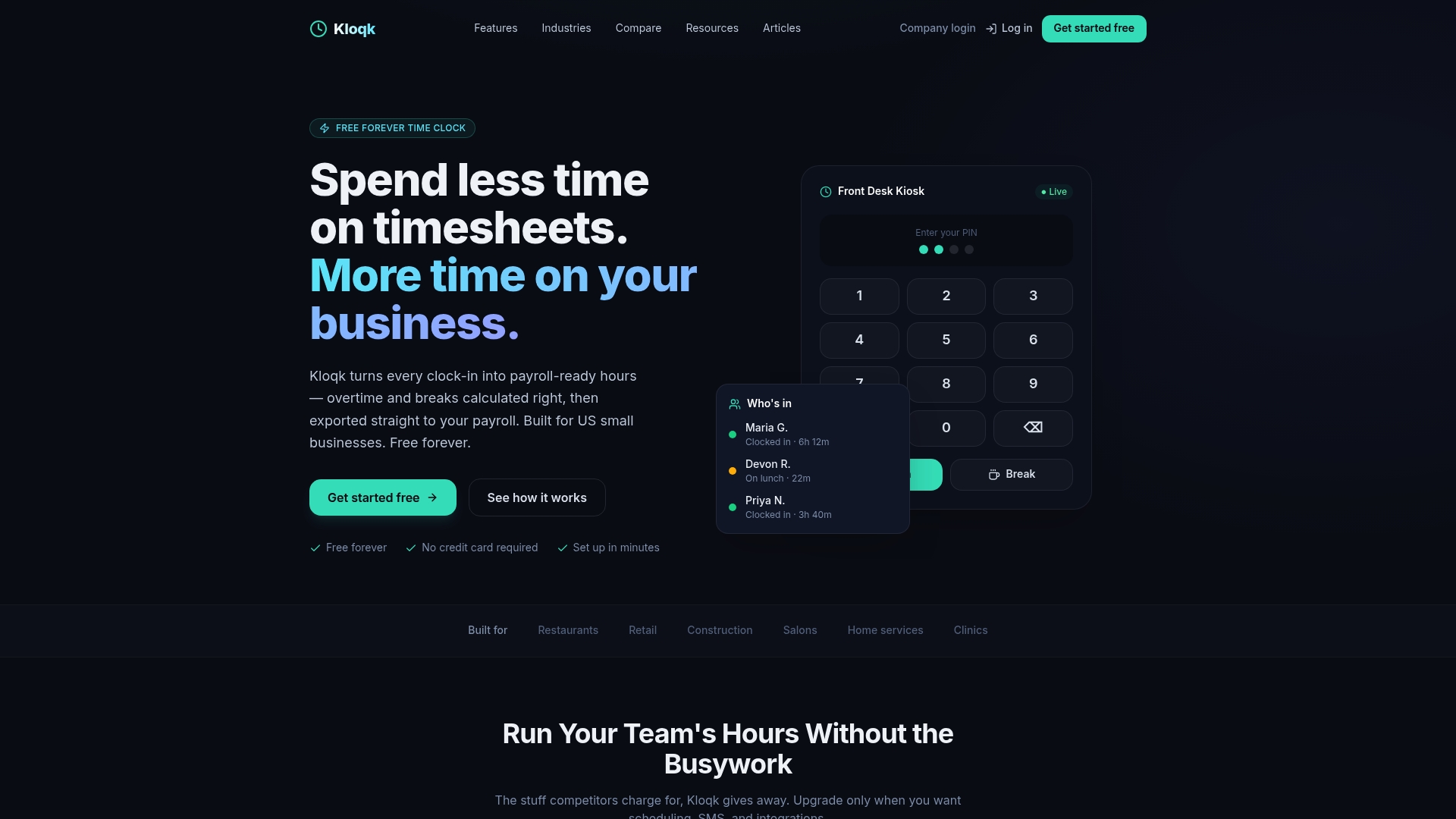
If you manage crews across several sites, GPS geofencing confirms punches happen where work happens, and our page on preventing buddy punching explains how photo and location checks work together. Start with the free employee time tracking software. Pro is $29 per month per location and Premium is $59 per month per location, and the full details are on the pricing page.
FAQ
Is paid sick leave required by federal law?
No. The Department of Labor says there is no federal law requiring private employers to provide it. The FMLA offers up to 12 weeks of unpaid, job-protected leave, and certain federal contractors must provide paid sick leave under Executive Order 13706.
Which states require paid sick leave?
As of December 2024, the Department of Labor counted 18 states and the District of Columbia with such laws, and the list has continued to change. Many cities and counties also have ordinances. Check your state labor department and your city’s labor standards office for the current rule.
Do you get paid for unused sick days in California?
Generally no. California employers are not required to pay out accrued, unused sick days when employment ends. If the employee is rehired within a year, the unused accrued days must be reinstated.
Can an employer ask for a doctor’s note?
It depends on the jurisdiction. Massachusetts, for example, allows written verification but bars requests for further medical or other documentation until an employee has used more than 24 consecutive hours or three days of earned sick time. Federal contractors may request certification for absences of three or more consecutive full workdays.
Do small businesses have to comply?
Often yes, though some laws use size thresholds or treat small employers differently. Connecticut, for instance, is extending coverage to employers with any employees beginning January 1, 2027. Confirm how your state counts employees.
Sources
- Sick Leave, U.S. Department of Labor
- Fact Sheet #84: Paid Sick Leave for Federal Contractors
- Questions and Answers, federal contractor sick leave, U.S. Department of Labor
- Paid Leave, U.S. Department of Labor
- Minneapolis Sick and Safe Time FAQs
- City of Berkeley Workforce Standards and Enforcement
- State Paid Sick Leave Laws, Connecticut Office of Legislative Research
- Connecticut paid sick leave amendments summary
- California Labor Code section 246
- 2026 Seattle Labor Standards Ordinances
- Earned Sick Time in Massachusetts FAQs
Sources
Every figure on this page traces to one of these. Primary law and government sources are listed first.
Written by
Dana WhitfieldHR Compliance Lead
Dana writes about wage-and-hour law, FLSA overtime, and leave compliance for U.S. small businesses, translating dense regulations into plain steps owners can act on.
Keep Reading
Track Hours the Easy Way
Kloqk is a free time clock that handles punches, breaks, overtime, and payroll-ready reports.
Start free