Time Clocks vs. Timesheets: Free FLSA Setup for Small Businesses

For hourly, on-site teams, an event-based time clock is the better fit; for project or consulting work, timesheets usually work better. Clocks record the exact minute someone starts and stops, which tightens payroll accuracy and cuts disputes. Timesheets capture task and project detail that clocks cannot, which matters for job costing and client billing. Whichever you pick, recordkeeping rules under the FLSA still apply.
TL;DR:
- The Department of Labor accepts clocks, timesheets, or handwritten records, provided employers keep complete, accurate records and wage computations for the required period.
- Rounding to five minutes, a tenth of an hour, or a quarter hour is allowed only when it does not systematically undercount hours worked.
- Businesses with mixed roles can use clocks for hourly staff and timesheets for project or salaried work, then reconcile both during payroll review.
- Pilot the system at one site or shift for two to four weeks, setting rounding, break, and overtime rules before employees begin using it.
- Keep an audit log, separate time entry from approval, and lock approved records against edits to preserve accountability and wage compliance.
Table of Contents
- What is a time clock versus a timesheet?
- Weighing accuracy, cost, and verification tradeoffs
- Matching the method to your business and workforce
- What compliance and recordkeeping actually require
- Rolling out a new time tracking system without disruption
- An editorial take on choosing the right method
- Put accurate time tracking to work for your team
- FAQ
- Sources
What is a time clock versus a timesheet?
A time clock records hours as they happen. An employee punches in through a kiosk, mobile app, or badge reader, and the system logs a timestamp tied to that exact moment. Many modern clocks add GPS geofencing, which confirms the punch happened at the job site, and photo verification, which confirms who actually punched in.
A timesheet works differently. Instead of capturing an event, it records a declared or reported entry, often filled in at the end of a shift, day, or week. Entries can include project codes, task descriptions, and billable hours, either typed into a spreadsheet or entered through time tracking tools.
The practical difference comes down to this:
- Time clocks capture hours as events, in real time, with location or identity verification.
- Timesheets capture hours as reports, often after the fact, with more detail about what the work was for.
- Clocks suit attendance-driven environments; timesheets suit project-driven or billable work.
Weighing accuracy, cost, and verification tradeoffs
The two methods trade different strengths for different weaknesses, and the choice usually comes down to which risk you’d rather manage: payroll accuracy or project detail.
- Time clock advantages: stronger timestamp accuracy, faster payroll reconciliation, built-in verification through photos or GPS, and fewer disputes over when someone actually started or stopped working.
- Time clock drawbacks: you need to manage devices or apps, set up rules before launch, and address employee privacy questions around location tracking.
- Timesheet advantages: detailed task and project-level data, support for job costing and client invoicing, and flexibility for roles where hours vary by assignment rather than by shift.
- Timesheet drawbacks: entries submitted late or estimated from memory, approval delays when managers are slow to review, and manual entry mistakes that compound over a pay period.
A University of California, Davis audit of mixed timekeeping systems found that manual timesheet processes created submission gaps and re-entry burdens, with heavy administrative workload falling on staff chasing missing records. That pattern repeats in small businesses too: the more manual the process, the more it depends on someone remembering to chase it down.
Pro Tip: If disputes over hours worked are a recurring headache, a clock’s timestamped record settles most arguments before they start.
Accurate records also protect both sides of the employment relationship. Our earlier piece on accurate timesheets covers how documentation habits reduce payroll conflicts regardless of which system generates the record.
Matching the method to your business and workforce
The right system depends less on industry and more on how your people get paid and what you need to prove later.
- Hourly retail, restaurants, and field crews: a time clock fits because pay is tied directly to shift attendance, and GPS verification confirms someone was actually on-site.
- Consulting, agencies, and professional services: timesheets fit because billing depends on task and project detail, not just clock-in times.
- Mixed environments (a restaurant with an hourly kitchen staff and a salaried events coordinator, for example) often run both: a clock for hourly roles and a lightweight timesheet for project or salaried work, reconciled during payroll review.
Before choosing, run through a short checklist: How much accuracy risk do late or estimated entries create for you? Do you bill clients or departments by project? Is your workforce mobile or field-based? How complex is your payroll process already? The answers usually point clearly toward one method or a hybrid.
What compliance and recordkeeping actually require
The Department of Labor does not mandate any specific timekeeping method: employers can use clocks, timekeepers, or employee-written records, as long as the records are complete and accurate and retained for the required period.
Rounding is where many small businesses get into trouble. The DOL’s elaws guidance permits rounding clocked times to the nearest five minutes, tenth of an hour, or quarter hour, but only when the rounding practice does not systematically undercount hours worked over time.
Operationally, a few controls matter more than the tool itself: keep an audit log of every edit, separate who approves time from who enters it, and avoid sending an already-approved timesheet back to an employee for correction, since that breaks the chain of accountability. A legal analysis in the Yale Journal of Law & Technology found that some electronic timekeeping features, like automatic defaults or unrestricted supervisor edit rights, can quietly undermine wage-and-hour compliance if the software doesn’t restrict who can change a record after the fact. Our guide to FLSA rounding rules walks through configuring these settings correctly.

Rolling out a new time tracking system without disruption
A short pilot beats a company-wide switch on day one. Start with a single site or shift, configure your rounding and break rules up front, and turn on photo or GPS verification before you expand further.
- Run a two to four week pilot with one location or shift before rolling out company-wide.
- Set rounding, break, and overtime rules before employees start clocking in, not after.
- Enable photo verification and GPS geofencing if any staff work off-site or across multiple locations.
- Define who approves time and lock edits after approval to preserve an audit trail.
We built our time clock around exactly this checklist: unlimited employees, overtime and break calculations, photo verification, and GPS geofencing are included, with payroll-ready exports so approved hours flow straight into your payroll run. Our cloud-based time tracking overview covers deployment details if you’re weighing a fully remote or multi-site rollout, and for teams that bill by task, our piece on attendance versus time tracking explains where the two approaches diverge.
An editorial take on choosing the right method
Given a choice, I lean toward clocks for any team paid by the hour, simply because a timestamp is harder to dispute than a memory. Timesheets still earn their place for project work and client billing, where the value is in the detail, not the exact minute. But the method matters less than the governance around it: clear rounding rules, locked edits after approval, and an audit trail will keep you compliant far more reliably than the brand of software you pick.
Saad
Put accurate time tracking to work for your team
Whichever method fits your team, the tool you use should make accuracy the default, not an extra step. A free plan may give you employee time tracking with overtime and break calculations and payroll exports built in, with no paywall on the basics. For field crews or multi-location teams, a GPS time clock with geofencing and remote time tracking app can add location verification.
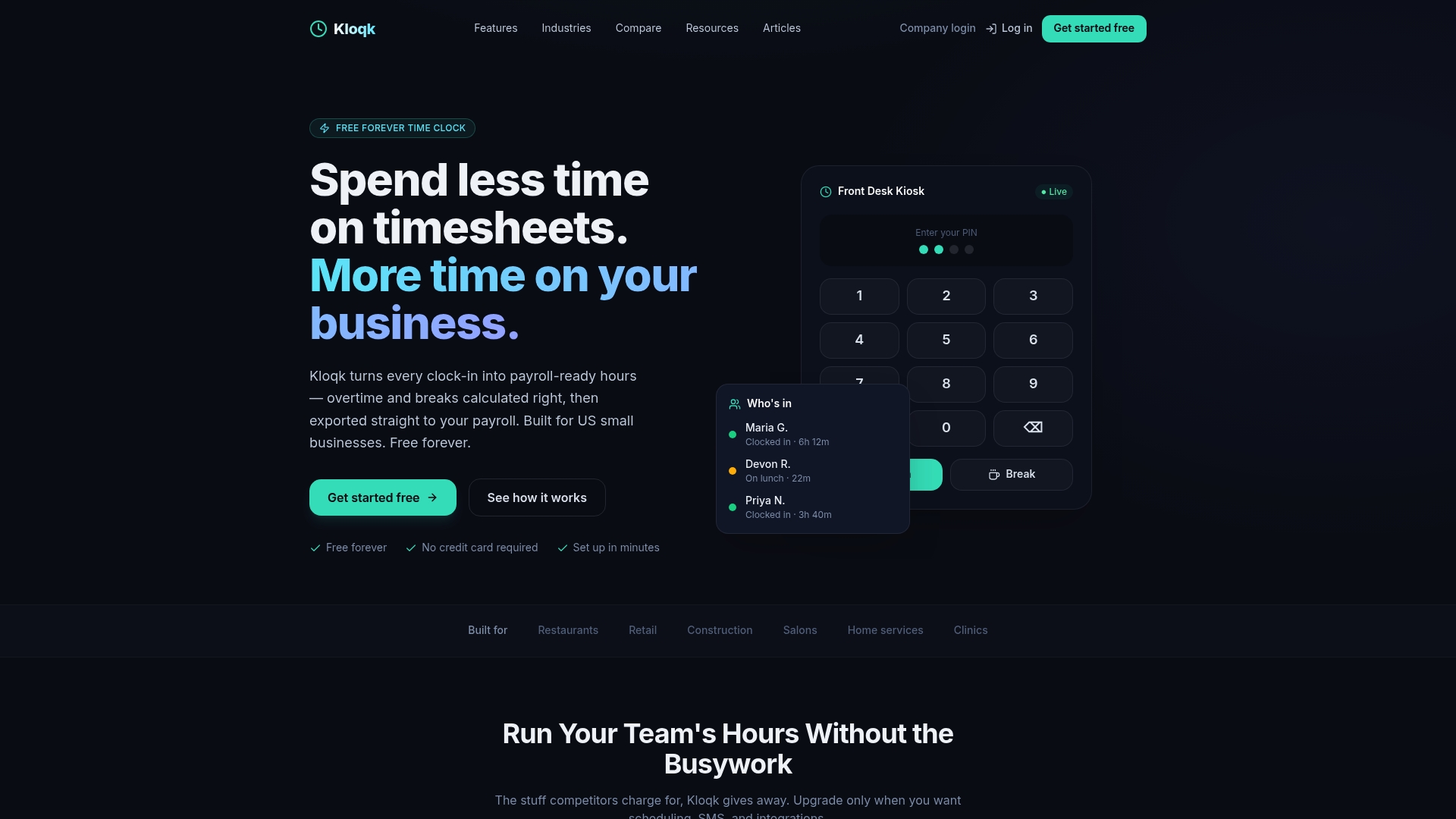
Compare plans, including optional upgrades for scheduling and PTO, on our pricing page, and start a free account to see payroll-ready hours on your first shift.
FAQ
What is the difference between a timer and a clock?
A timer measures elapsed duration for a single task or session, counting up or down from a starting point. A time clock records specific timestamps, such as when someone starts and ends a shift, which is what payroll systems use to calculate hours worked.
Which spelling is correct, timesheet or time sheet?
Both spellings appear in common use, though “timesheet” as one word is now the more widely used form in payroll and HR software. Either spelling refers to the same record of hours worked, so consistency within your own documents matters more than which version you choose.
Is timekeeping part of payroll?
Yes, timekeeping is the input that payroll calculations depend on. Employers must retain accurate records of hours worked and wage computations for a required period, and payroll cannot be calculated correctly without that underlying time data.
What is the purpose of a timesheet?
A timesheet documents the hours an employee worked, often broken down by task, project, or client. This detail supports accurate payroll, project billing, and job costing, and it also serves as part of the recordkeeping employers need to stay compliant.
Does the government require a specific time tracking method?
No single method is required. The Department of Labor allows any approach, from clocks to handwritten records, as long as the records are complete, accurate, and retained for the required period.
Sources
- Fact Sheet #21: Recordkeeping Requirements under the Fair Labor Standards Act (FLSA) | U.S. Department of Labor
- elaws, FLSA Hours Worked Advisor
- When Timekeeping Software Undermines Compliance | Yale Journal of Law & Technology
- University of California, Davis Time reporting internal audit
Recommended
Sources
Every figure on this page traces to one of these. Primary law and government sources are listed first.
- 1. U.S. Department of Laborprimary
- 2. U.S. Department of Laborprimary
- 3. U.S. Department of Laborprimary
- 4. expressplanner.io
- 5. auditreports.ucop.edu
- 6. yjolt.org
Written by
Marcus ReyesPayroll & Timekeeping Specialist
Marcus covers payroll accuracy, timesheets, and time tracking, the unglamorous mechanics that keep paychecks correct and audits painless.
Keep Reading
Track Hours the Easy Way
Kloqk is a free time clock that handles punches, breaks, overtime, and payroll-ready reports.
Start free