Stop Late Timesheets: 5 Manager Decisions for Timesheet Reminders

The best approach is simple: automate targeted reminders on a fixed cadence, send only to people who still owe you a timesheet, and escalate automatically when reminders get ignored. Behavioral research on time discounting shows people respond to near-term nudges far better than distant deadlines, which is why cadence matters more than the message itself. Pair that with DOL recordkeeping guidance and a tool like Kloqk, and the rest of this guide walks through exactly how to build it.
TL;DR:
- Sending reminders only to employees with unsubmitted timesheets and setting escalation thresholds reduces unnecessary messages and increases compliance.
- Using SMS for field staff and in-app push notifications for quick actions achieves higher read rates than email or Slack, depending on the workforce’s habits.
- A four-stage reminder cadence, pre-deadline, deadline, overdue follow-up, and escalation, consistently outperforms single deadline reminders.
- Configuring reminders with correct permissions, time zones, and conditional targeting prevents over-messaging and automation errors.
- Tracking submission rates, delays, and repeat offenders every pay period enables targeted escalation and better process management.
Table of Contents
- Quick Checklist: Steps To Implement Timesheet Reminders This Week
- Which Reminder Channel Actually Reaches Your Team?
- Copyable Templates And A Cadence That Works
- How To Configure Reminders Without Breaking Anything
- Escalation And Reporting Without Losing Trust
- Best Practices And Pitfalls To Avoid
- What I’ve Learned Watching Small Teams Fix This
- Let Kloqk Handle The Chasing
- Sources
Quick Checklist: Steps To Implement Timesheet Reminders This Week
You don’t need a committee meeting to fix late timesheets. You need five decisions made in the right order, and most managers can knock this out in an afternoon.
- Set the hard deadline and cadence. Weekly payroll typically has a cutoff on a Friday at midday; biweekly payroll periods often end on the Monday following the pay period. Pick one and write it down somewhere everyone can find it.
- Choose delivery channels and test them. Email for office staff, SMS or push for field crews, Slack for teams that live there already. Send yourself a test message first.
- Define recipient rules. Decide whether reminders go to “everyone” (simple, but annoying to compliant employees) or “only unsubmitted” (better, but requires a system that tracks submission status in real time).
- Build templates with one clear link and one clear action. No multi-step instructions. One tap, one submission.
- Set escalation thresholds. Decide in advance how many missed reminders trigger a manager alert, and how many trigger a payroll flag.
Write these five decisions into a one-page policy. It takes fifteen minutes and saves you from relitigating the same argument with HR every quarter.
Which Reminder Channel Actually Reaches Your Team?
Email, SMS, Slack, and in-app push all work, but they don’t work the same for every workforce, and picking the wrong one is the most common reason reminder programs fail quietly.
- Email is cheap and easy to automate but has the slowest read rate for hourly staff who don’t check inboxes during a shift.
- SMS gets opened fast, often within minutes, and works well for construction crews, delivery drivers, and anyone without a company email habit.
- Slack or Teams notifications work well only if your staff already lives inside that tool daily; if it’s mostly used by office staff, don’t expect warehouse workers to see it.
- In-app push through your time clock app tends to have the tightest loop between reminder and action, since the employee is already one tap from clocking in or submitting.
- Webhooks and tools like Zapier or Make let you route reminders into whatever channel you already use, which matters most for mixed teams spanning office and field roles.
Built-in reminders inside your timesheet system are usually enough for a single-location business. Multi-location or multi-tool operations often need webhook-based automation to keep everything synced without double messaging the same person.
Pro Tip: Match the channel to where people already spend their attention during work hours, not where you wish they spent it. A construction foreman checking email once a day will miss a Tuesday reminder every single time.
Admin permissions for most systems require an owner or manager role to enable SMS or webhook integrations, since those often touch billing or third-party API access.
Copyable Templates And A Cadence That Works
A four-stage cadence beats a single deadline day nag almost every time, because it gives people multiple low-friction chances to act before anything feels like a scolding.
- Pre-deadline (24 to 48 hours before): “Quick heads up: timesheets are due Friday at noon. [Submit here]. Takes about two minutes.”
- Deadline-day: “Timesheets close today at noon. If you’ve already submitted, ignore this. [Direct link].”
- Overdue follow-up (same day, evening or next morning): “Your timesheet from this week hasn’t come through yet. Payroll runs tomorrow, so this needs to happen today. Need help? Reply here.”
- Escalation (after two missed reminders): manager gets copied, and the tone shifts from nudge to notice: “This is the third reminder for [Name]'s timesheet. Please follow up before end of day.”
Keep the subject line specific (“Timesheet due today, 12pm”) rather than generic (“Reminder”). For SMS and Slack, cut everything down to one line: “Timesheet due today by noon. Tap to submit: [link].” Field workers won’t read three paragraphs on a phone between jobs, and they shouldn’t have to.
Framing the ask around outcomes, like payroll accuracy or getting paid on time, tends to land better than framing it as a compliance chore nobody asked for.
How To Configure Reminders Without Breaking Anything
Setting this up correctly the first time saves you from a flood of angry Slack messages the second.
- Permissions: only owners or admin-level managers should be able to create or edit reminder rules, since a miswritten rule can spam an entire team or, worse, nobody at all.
- Recurring schedules: set the reminder time zone to match where your staff actually works, not your own office. A reminder set in Eastern time sent to a Phoenix crew at “9am” will land at 6am local.
- Conditional targeting: configure reminders to fire only for people with unsubmitted timesheets, or below a set capacity threshold, rather than blasting the whole roster every time.
- Automation and webhooks: if you’re routing reminders through Zapier, Make, or a direct webhook into Slack or SMS, test with a small pilot group first. Throttle notifications carefully if someone belongs to more than one recipient group, since overlapping group and individual rules are the number one cause of duplicate messages.
Escalation And Reporting Without Losing Trust
Track three numbers every pay period: percent submitted by deadline, average delay in hours, and repeat offenders (anyone late two or more periods running). Those three tell you whether the problem is a process issue or a person issue.
A workable escalation recipe: after two missed reminders, the direct manager gets notified. After three, payroll gets flagged so pay doesn’t go out on guesswork. Format weekly reports for leadership around those same three metrics rather than raw submission logs, which nobody reads.

Keep documentation of every reminder sent and every escalation triggered. DOL recordkeeping requirements put the burden of accurate hours records on the employer, not the employee, so a paper trail on your side protects you if a dispute ever surfaces. A structured approval workflow makes that documentation almost automatic.
Best Practices And Pitfalls To Avoid
- Do keep every message under three sentences with one link and one action.
- Do target reminders only at people who haven’t submitted, not the whole team.
- Don’t escalate to a manager after a single missed deadline. Follow the documented two-strike path instead.
- Watch for ambiguous deadlines (“end of week” means different things to different people), wrong time zones, and overlapping recipient groups that double-send the same nudge.
Pro Tip: If two reminder rules can technically apply to the same person, they eventually will. Audit your recipient groups quarterly, not just when someone complains about getting three copies of the same text.
What I’ve Learned Watching Small Teams Fix This
Across small teams, the fix is rarely a fancier tool. It’s a shorter cadence and a shorter message. Teams that switch from one deadline-day email to a three-stage sequence usually see the difference within the first pay period, mostly because the pre-deadline nudge catches people before they’ve mentally checked out for the week.
A one-month rollout that works: week one, set the deadline and cadence. Week two, add conditional targeting so only stragglers get pinged. Week three, add the escalation rule. Week four, review the three core metrics and adjust wording on whichever template has the worst response rate.

Saad
Let Kloqk Handle The Chasing
Some time clock systems build reminders directly into the platform, reducing the need to stitch together separate apps to remind people about hours.
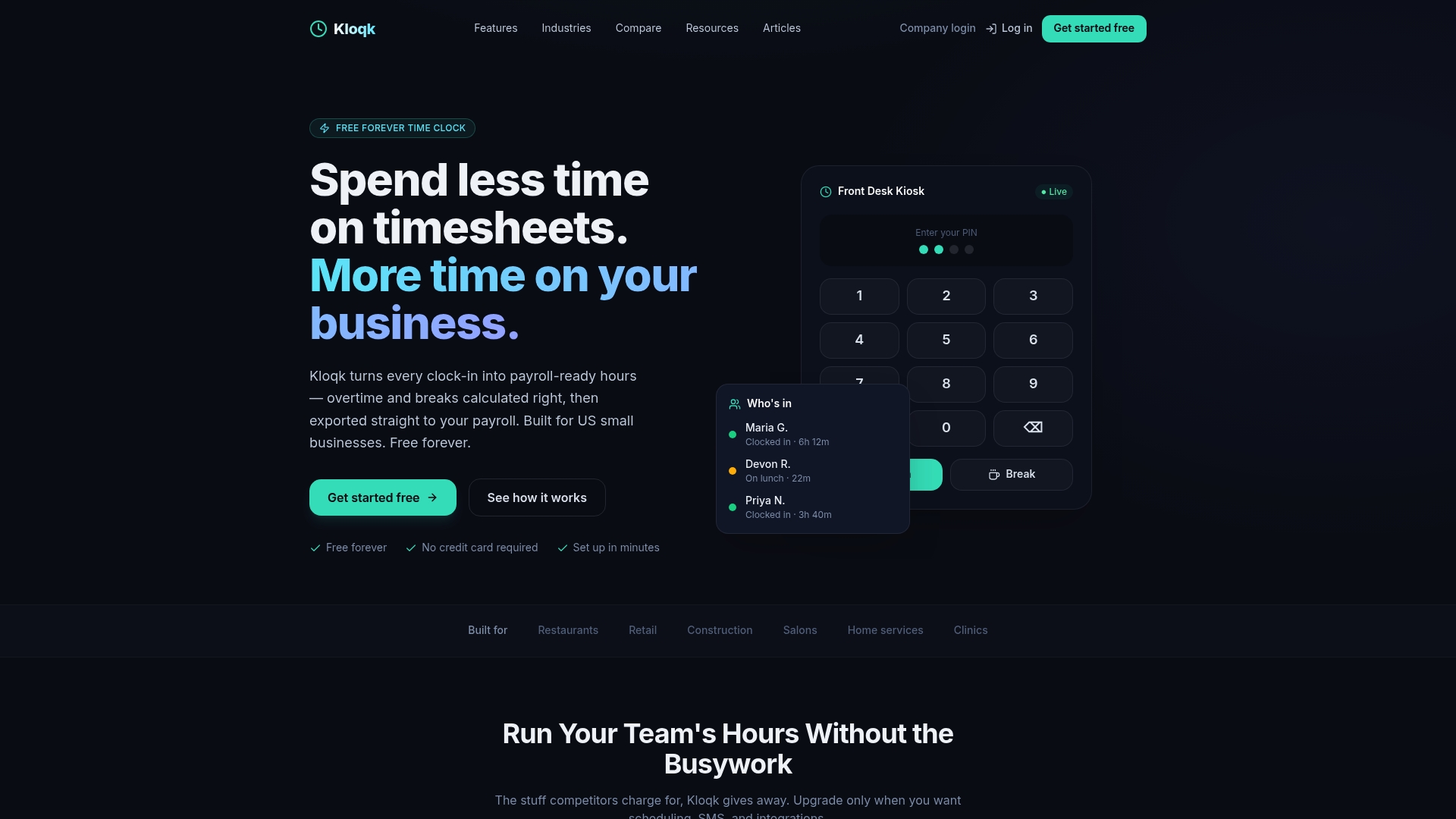
Some platforms include automated reminders, mobile push and SMS notifications, payroll-ready exports, and photo or GPS verification at clock-in, tying reminders to the system that logs the hours. That closes the gap between “reminded” and “recorded” instead of leaving it to a spreadsheet somewhere. You still set the cadence, the recipient rules, and the escalation thresholds. Kloqk just removes the manual work of sending, tracking, and following up on every single one. If you’re building the rollout plan from scratch, a 60-day automation guide can help you sequence the setup alongside your existing payroll calendar. To see how the reminder and time clock system works together, check the free employee time tracking features and set up your first reminder rule today.
Sources
Recommended
Sources
Every figure on this page traces to one of these. Primary law and government sources are listed first.
- 1. U.S. Department of Laborprimary
- 2. cmu.edu
- 3. semlocal.co.uk
Written by
Marcus ReyesPayroll & Timekeeping Specialist
Marcus covers payroll accuracy, timesheets, and time tracking, the unglamorous mechanics that keep paychecks correct and audits painless.
Keep Reading
Track Hours the Easy Way
Kloqk is a free time clock that handles punches, breaks, overtime, and payroll-ready reports.
Start free