Scheduling Disputes in Restaurant Teams: A Manager's Fix

Most scheduling disputes in restaurants trace back to two fixable problems: schedules posted too late for staff to plan around, and no written rules for swaps or call-outs. The single most effective immediate fix is a published schedule posted at least one week out, paired with a one-page written swap policy every employee signs. INFORMS research links unpredictable schedules directly to lower employee performance and lost restaurant revenue, which means this is not just a morale issue.
Here is why that combination works:
- Unpredictability breeds perceived unfairness. When staff cannot see the schedule until two days before the week starts, they assume favoritism fills the gaps.
- No written swap rules create chaos. Without a policy, every swap becomes a negotiation, and managers end up making inconsistent calls that erode trust.
- Late schedules cause no-shows. Staff who cannot plan childcare or a second job simply do not show up, or they call out at the last minute.
- The U.S. Department of Labor requires accurate recordkeeping of hours worked and wages paid, so every scheduling decision you make has a paper trail implication.
Key Takeaways
Scheduling disputes in restaurants are almost always process failures, not people failures. Fix the posting window and the swap policy first, and most disputes stop before they start.
| Point | Details |
|---|---|
| Post schedules early | Publish the schedule well ahead of time to reduce last-minute no-shows and perceived favoritism. |
| Write the swap policy down | A one-page written policy with manager approval stops unauthorized swaps and inconsistent rulings. |
| Use photo and GPS time tracking | Photo clock-ins and GPS geofencing resolve time-theft disputes before they reach payroll. |
| Document every dispute | Record the date, policy applied, and outcome; follow up within one week to close the loop. |
| Confirm state break and overtime rules | Federal law sets the FLSA floor; your state may require daily overtime or mandatory meal breaks. |
Table of Contents
- What are the most common scheduling disputes restaurant teams face?
- Why do these disputes keep happening?
- How to resolve an active scheduling dispute right now
- Policies and routines that prevent most scheduling disputes
- What scheduling and time-tracking features actually reduce conflicts?
- How a small restaurant stopped disputes with two simple changes
- U.S. legal and recordkeeping considerations to check now
- The advice most managers skip, and why it costs them
- Try Kloqk free and cut scheduling disputes this week
- Sources
What are the most common scheduling disputes restaurant teams face?
Practical scheduling guides consistently catalog the same handful of disputes across restaurant types and sizes. Knowing which one you are dealing with helps you match the right fix.
- No-shows and last-minute call-outs. A server texts at 4 PM that they cannot make the 5 PM dinner rush. Coverage scrambles, and the team resents covering.
- Unauthorized shift swaps. Two line cooks trade shifts without telling anyone. The replacement is not trained on the station, and service suffers.
- Last-minute schedule changes. A manager cuts a shift the morning of because reservations look slow. The employee already arranged childcare and drives in anyway.
- Perceived favoritism. One bartender always gets Friday nights; another always gets Tuesday lunches. No one can see why, so staff assume it is personal.
- Clopens and back-to-back shifts. A host closes at midnight and opens at 7 AM. Fatigue shows up in service quality and eventually in a complaint or a call-out.
- Overtime and break disputes. An employee clocks 41 hours because a manager forgot to check the weekly total. Or a dishwasher never gets a 30-minute meal break on a double.
- Time theft and double-punching. A friend clocks in for a late employee. Without a photo or GPS verification, there is no way to know until payroll runs.
Each of these disputes has a direct cost: overtime you did not budget, a service gap during peak hours, or a labor complaint filed with your state labor board.
Why do these disputes keep happening?
Blaming individual employees is the wrong diagnosis. Most restaurant staffing conflicts are process failures, not people failures. ShiftForce’s review of academic findings confirms that predictability, transparency, and structured flexibility are the three levers that reduce conflicts, and all three are process decisions, not personality fixes.
- No consistent posting window. If the schedule sometimes drops Monday and sometimes Thursday, staff cannot plan, and last-minute conflicts multiply.
- Availability data is scattered. Texts, sticky notes, and verbal requests mean the manager building the schedule is working from memory, not facts.
- Manual scheduling errors. A spreadsheet does not flag that you scheduled someone for 48 hours or that two people requested the same day off.
- Understaffing and high turnover. When you are perpetually short-staffed, every call-out is a crisis. Turnover resets the problem every few months.
- No written swap or time-off policy. Verbal rules are applied inconsistently. One manager approves a swap; another denies the same request the next week.
- Role and skill mismatches. Scheduling a prep cook on the grill station because you are short creates service problems and resentment from the employee who was not trained for it.
- Poor communication channels. A group text thread where scheduling messages get buried under memes is not a communication system.
A Russell Sage Foundation work-scheduling study found that managers who applied predictable posting windows and structured flexibility saw fewer conflicts and greater staff acceptance, which points directly at the posting window as the highest-leverage fix.
Pro Tip: Most managers diagnose disputes at the symptom level (the no-show, the swap argument) and miss the upstream cause. Check your last hire’s onboarding: did they receive a written scheduling policy on day one? If not, your dispute problem starts at orientation, not on the floor.
How to resolve an active scheduling dispute right now
When a dispute lands on your desk mid-service, you need a repeatable process, not improvisation. Here is a workflow that covers triage through follow-up.
Immediate triage checklist
- Confirm coverage first. Before any conversation, make sure the shift is covered. Call in a backup, offer an open shift, or step in yourself if needed.
- Protect service standards. Do not put an untrained employee on a station just to fill a body. A gap in coverage is better than a service failure that costs you a review.
- Acknowledge the dispute privately. Pull the employee aside after the rush, not during it. Public confrontations escalate fast in a kitchen.
Manager script for the private conversation
Keep it fact-based and policy-forward. Here is sample language:
“I want to talk about what happened with [the shift/swap/call-out]. Here is what I know: [state the facts]. Our policy says [state the rule]. Going forward, here is what I need from you: [state the expectation]. Do you have any questions about the policy?”
That structure does three things: it anchors the conversation in facts, it references the written rule so it is not personal, and it closes with a clear expectation.
Decision rules for swaps and call-outs
- Approve a swap when both employees are trained for the station, the replacement is not approaching overtime, and the request came through the approved channel with at least 24 hours’ notice.
- Deny a swap when the replacement lacks the required skill, the request bypasses the written process, or approving it creates an overtime liability.
- Apply makeup shifts or corrective action consistently. If one no-show gets a written warning, the next one does too. Inconsistency is what turns a policy into a grievance.
Documentation steps
Record the date, the employee involved, the specific dispute, the policy section applied, and the outcome. Store it in the employee’s file. Follow up within one week with a brief check-in: “How are things going? Any questions about the policy?” That follow-up signals you are managing, not just punishing.

Pro Tip: After a dispute is resolved, a small gesture goes a long way toward restoring morale: a shift meal, a preferred shift the next week, or a simple acknowledgment in front of the team that the issue is closed. Staff remember how you handled it after the fact.
Policies and routines that prevent most scheduling disputes
The goal is to make disputes structurally unlikely. Altametrics recommends routine availability collection, firm deadlines, clear written policies, and a backup on-call pool as the core prevention stack. Here is how to build that.
Core policy elements every restaurant needs
- Posting window: Schedules posted no later than 7 days before the work week starts (10 days is better for staff with second jobs or childcare).
- Availability deadline: Staff submit availability changes by a fixed day each week (e.g., Wednesday by noon for the following week’s schedule).
- Shift-swap protocol: All swaps submitted in writing through a single channel (app, form, or designated group), with manager approval required before the swap is confirmed.
- Call-out protocol: Staff must notify the manager directly (not just a coworker) at least 2 hours before their shift. A text to a group chat does not count.
- Clopen protection: No employee scheduled to close and open with fewer than 8 hours between shifts without written consent.
- Overtime and break rules: Managers check weekly hour totals before publishing the schedule. Meal breaks follow your state’s requirements (see the legal section below).
- Fairness and rotation rules: Desirable shifts (Friday nights, holiday weekends) rotate on a documented schedule. See rotating shift schedule guidance for practical examples.
Sample scheduling policy template
Use this as the foundation for a staff-facing document:
[Restaurant Name] Scheduling Policy Schedules are posted every [day] by [time] for the following week. Availability changes must be submitted by [day/time]. Shift swaps require written approval from a manager at least 24 hours in advance. Unauthorized swaps may result in corrective action. Call-outs must be reported directly to [manager/role] at least 2 hours before the shift. Repeated call-outs without notice will be addressed under the attendance policy. Overtime requires prior manager approval.
Implementation checklist
- Share the written policy with all current staff and collect signatures.
- Include the policy in new-hire onboarding packets from day one.
- Train every manager and shift lead on how to apply the policy consistently.
- Pilot the policy for two full pay periods before making adjustments.
- After the pilot, track: late schedule changes per pay period, no-show frequency, and swap-request volume. If any metric is not improving, identify which policy element is not being enforced.
Pro Tip: Run the pilot during a slower season if possible. Launching a new scheduling policy during a holiday rush creates resistance because staff associate the change with stress, not improvement.
What scheduling and time-tracking features actually reduce conflicts?
Fix the process before buying software. A tool automates the process you already have. Once your policies are written, look for features that enforce them.
Feature checklist mapped to specific disputes
- Single shared schedule (cloud-based, visible to all staff): Eliminates the “I didn’t see the schedule” excuse and the version-control problem of emailed spreadsheets.
- Published posting windows with push notifications: Staff get an alert when the schedule drops, removing the “I didn’t know” defense for no-shows.
- Digital availability collection: A form or in-app request replaces scattered texts and sticky notes, giving the scheduler a single source of truth.
- Open shift posting: When a shift opens up, it goes to eligible staff first. Managers approve the fill. This replaces the frantic group-text scramble.
- Swap requests with manager approval: Staff submit swaps through the system; the manager approves or denies with one tap. The audit trail is automatic.
- Photo verification for clock-ins: A photo taken at clock-in ties the punch to a face, which eliminates buddy-punching disputes without confrontation.
- GPS geofencing: Clock-ins are only accepted from the restaurant location, which stops remote punches and resolves time-theft disputes before they start.
- Automated overtime alerts: The system flags an employee approaching 40 hours before the schedule is published, not after payroll runs.
- Payroll-ready timesheets: Hours, breaks, and overtime export directly to payroll, reducing manual entry errors that create pay disputes.
Microsoft’s Shifts documentation notes that role configuration matters as much as the feature set: a manager without the correct Schedule Owner permissions cannot create or modify schedules, which is a common operational failure point. Assign schedule-management roles at the admin level before you go live.
For multi-shift payroll setup, confirm that your time-tracking tool exports break time and overtime separately so your payroll processor can apply the right rates.
How a small restaurant stopped disputes with two simple changes
Consider a 35-seat neighborhood restaurant running two shifts, six days a week, with 14 hourly employees. Before any changes, the manager rebuilt the schedule almost every week due to swaps, no-shows, and overtime surprises. Here is what changed and what happened.
The two changes: The manager started posting the schedule 10 days ahead every Thursday, and introduced a one-page written swap policy with a 24-hour notice requirement and manager approval via a shared app. A photo time clock was installed at the kitchen entrance.
- Week 1-2: Staff tested the new swap process. Two requests came in without 24-hour notice and were denied per policy. The manager applied the rule consistently both times.
- Week 3-4: Swap requests dropped because staff planned further ahead. No-shows fell from roughly two per week to one in the first month.
- Week 5-6: The photo time clock flagged one buddy-punch attempt. The manager addressed it privately using the documented policy. No repeat.
- Week 7-8: Payroll ran without a single manual correction for the first time in months. The manager estimated saving two hours of administrative time per pay period.
The photo verification feature maps directly to what Kloqk’s time tracking provides: clock-in photos tied to each punch, GPS confirmation of location, and payroll-ready exports that remove the manual reconciliation step.
Pro Tip: Post the new schedule on the same day and at the same time every week. Predictability of the posting itself is almost as important as the lead time. Staff start checking on Thursday at noon because they know it will be there.
U.S. legal and recordkeeping considerations to check now
This section is general information, not legal advice. Confirm current rules with the U.S. Department of Labor or a qualified employment attorney.
- FLSA overtime: Non-exempt employees must be paid 1.5× their regular rate for hours over 40 in a workweek. There is no federal daily overtime threshold, but some states (California, Nevada, Alaska) have daily overtime rules.
- Meal and rest breaks: Federal law does not require meal breaks for adults, but most states do. Requirements vary by state and shift length. Check your state labor office for the specific rule.
- Predictive scheduling / Fair Workweek laws: Most small restaurants are exempt from municipal Fair Workweek ordinances, which typically apply to large chains above a revenue or employee-count threshold. Still, confirm your city and state thresholds, because some jurisdictions are expanding coverage.
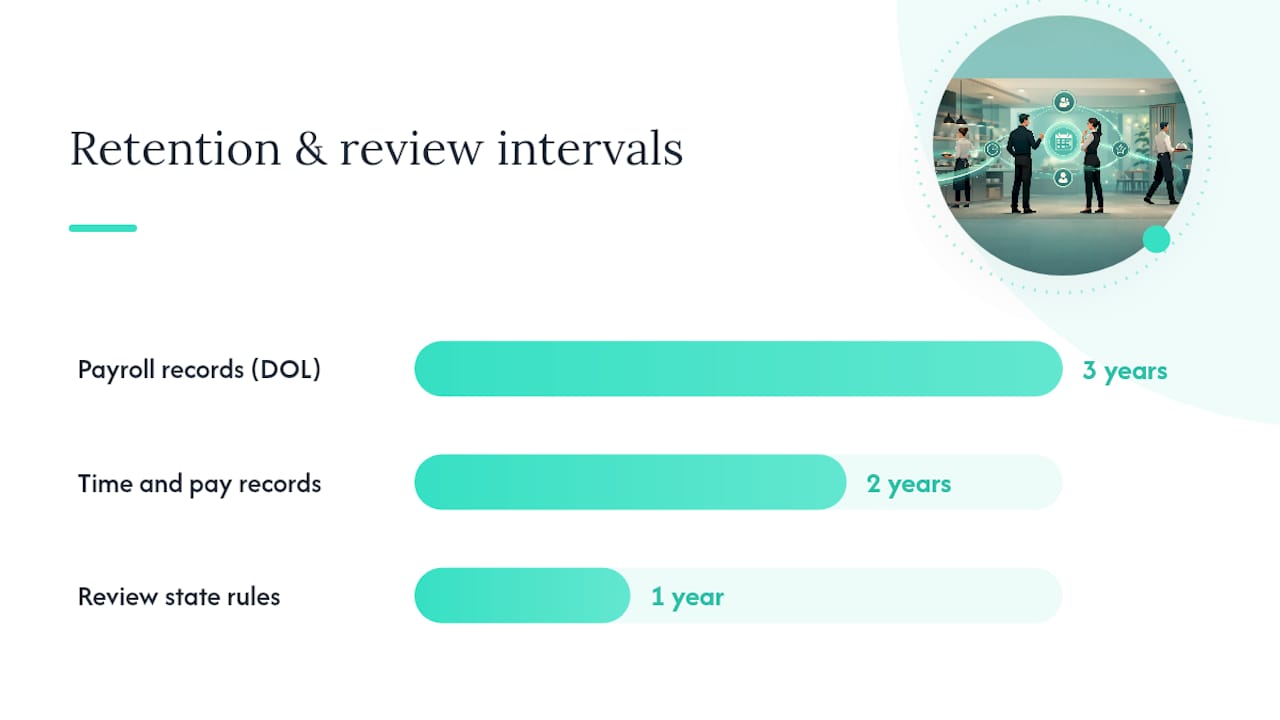
- Recordkeeping obligations: The U.S. Department of Labor requires employers to keep payroll records for at least three years and time/pay records for at least two years. Scheduling records that document hours worked and break times support your compliance position in any audit or wage claim.
- Predictability pay: Where applicable (San Francisco, New York City, Chicago, Seattle, and others), employers owe employees additional pay for last-minute schedule changes. Confirm whether your city’s ordinance applies to your restaurant size.
Keep scheduling records for every pay period, not just payroll runs. A documented audit trail showing consistent policy application is your best defense in a wage-and-hour dispute.
Pro Tip: Set a calendar reminder to review your state’s meal and rest break rules once a year. State labor agencies update guidance, and a rule that did not apply to you last year may apply now if your headcount has grown.
The advice most managers skip, and why it costs them
The standard guidance on scheduling disputes is not wrong, it is just incomplete. Every article tells you to post schedules earlier and write a swap policy. That is correct. What they skip is the sequencing problem: most managers try to fix disputes with software before they have fixed the underlying policy, and the software just automates the chaos faster.
The real order of operations is: write the policy, train every manager on it uniformly, then configure a tool to enforce it. A swap-approval workflow in an app means nothing if one shift lead approves swaps verbally anyway. The technology is only as consistent as the humans behind it.
The second thing most guides underweight is the cost of inconsistency over time. A single inconsistent ruling (approving a swap for one employee that you denied for another last month) does more damage to team trust than a dozen denied requests applied fairly. Staff do not resent rules. They resent rules that seem to apply selectively. That is the actual driver of most “favoritism” complaints, and it is entirely within a manager’s control.
My honest take: the managers who have the fewest scheduling disputes are not the ones with the best software. They are the ones who made the policy boring and predictable. When staff already know the answer before they ask, they stop asking in ways that create disputes.
Try Kloqk free and cut scheduling disputes this week
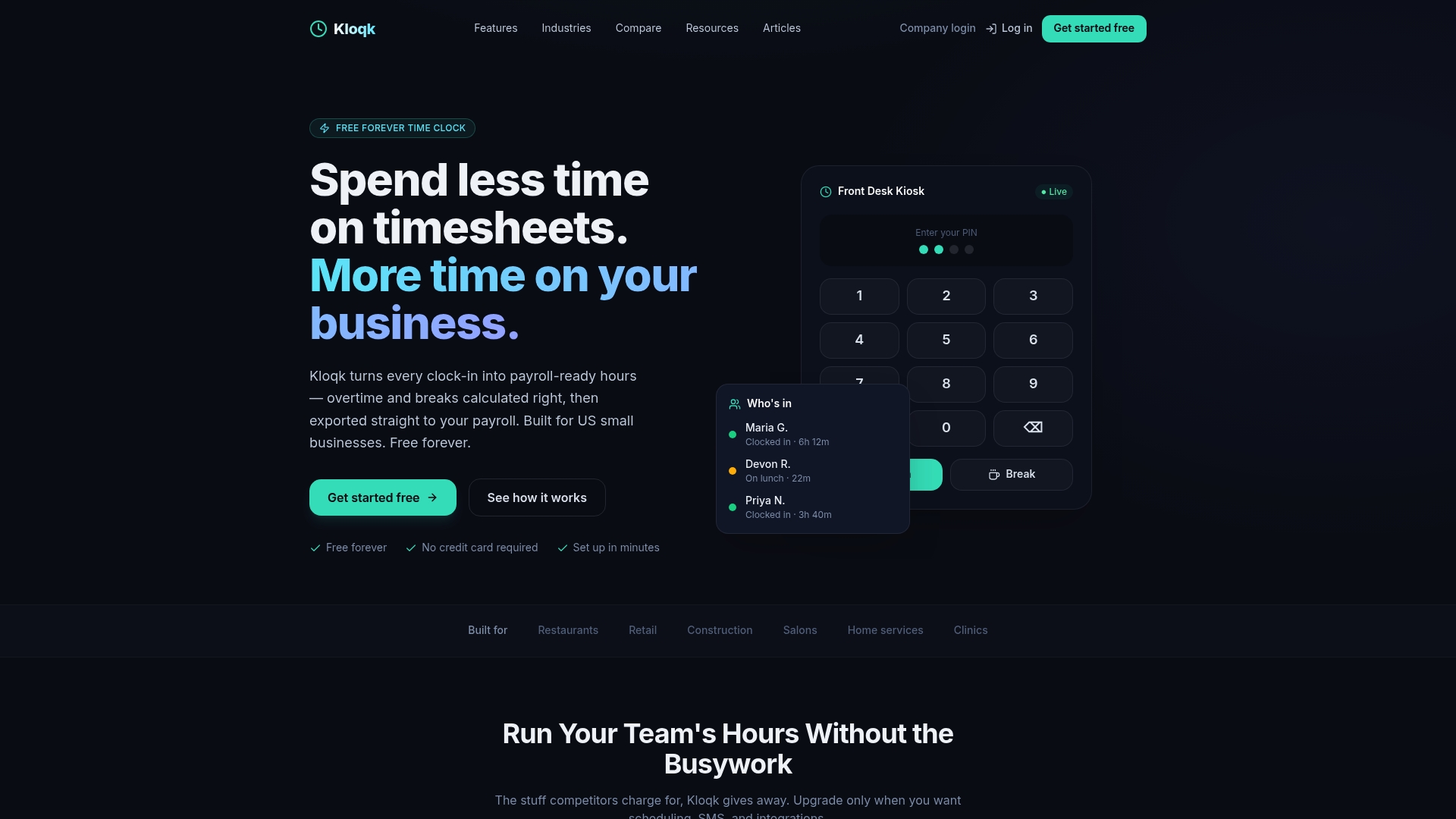
Kloqk gives restaurant managers a free time clock with photo verification, GPS geofencing, and payroll-ready timesheets built in. No per-feature charges for overtime calculations or break tracking. Set up takes minutes, and the audit trail starts from the first clock-in.
Start free time tracking and pair it with a published schedule to close the two biggest gaps that drive disputes. If you need a schedule template to get started, the employee shift schedule template at Kloqk is ready to adapt for your team today.
This article is general information, not a substitute for advice from a qualified lawyer. Consult a qualified legal professional about your own circumstances before acting on anything here.
Sources
- Scheduling issues in Shifts
- New Research Shows Unpredictable Work Schedules Impact Restaurant Revenue
- Employee Scheduling Problems and How to Fix Them | FirstHR
- How Can I Reduce Shift Scheduling Conflicts in My Restaurant?
- How Can Restaurants Prevent Scheduling Conflicts and Last-Minute Absences?
Recommended
Sources
Every figure on this page traces to one of these. Primary law and government sources are listed first.
- 1. U.S. Department of Laborprimary
- 2. informs.org
- 3. firsthr.app
- 4. shiftforce.com
- 5. russellsage.org
- 6. altametrics.com
- 7. learn.microsoft.com
Written by
Sam TolbertWorkforce Operations Editor
Sam writes about scheduling, shift work, and the software that runs an hourly workforce, what actually saves time on the floor versus what just adds clicks.
Keep Reading
Track Hours the Easy Way
Kloqk is a free time clock that handles punches, breaks, overtime, and payroll-ready reports.
Start free