Construction Payroll Mistakes and How to Prevent Them

Most construction payroll mistakes start before payroll does: hours that were guessed at the end of the week, a worker put in the wrong category, or a prevailing wage rate nobody checked. Fix the source, meaning the time record, and the overtime, classification and certified payroll problems get much smaller. Kloqk’s free time clock records punches with photo verification and turns them into payroll-ready hours with overtime and break calculations, so the office is not rebuilding the week from memory on Friday.
TL;DR
- The costliest mistakes are misclassifying workers, miscalculating overtime, and filing wrong or late certified payroll on public jobs.
- Errors are expensive: back wages, interest, penalties of up to $5,000 per worker under prevailing wage rules, personal liability for unpaid payroll taxes, and possible federal debarment.
- Most errors are data problems. Hours recorded at the moment of work beat hours reconstructed later.
- Federal, state and local rules stack, so a crew can be compliant federally and still wrong in its state.
- When you find a mistake, document it, correct it quickly and fix the process that produced it.
Table of Contents
- The mistakes that cost contractors the most
- What one mistake can cost
- Why prevention starts with the time record
- Perspective
- What to do when you find a mistake
- Putting it into practice with Kloqk
- FAQ
- Sources
The mistakes that cost contractors the most
Construction payroll is harder than payroll in most trades. Crews move between job sites, work split shifts, travel, and sometimes work on public projects with their own wage rules. Small slips repeat every week, and a repeated slip becomes a pattern an auditor can count.
Here are the mistakes that show up again and again, roughly in order of what they cost.
1. Misclassifying employees as independent contractors
Calling a worker a contractor to avoid overtime and payroll taxes is the single most expensive mistake a business can make, according to a March 2026 payroll roundup. We cannot vouch for that ranking as a legal fact, so look at the numbers from an official source instead. A 2019 report from the District of Columbia Office of the Attorney General found that a construction contractor can cut labor costs by 16.7% through misclassification. For every $100 of labor cost, the employer saves $11.50 by skipping overtime and shifting payroll taxes to the worker, and another $5.20 by avoiding unemployment insurance taxes and lowering workers’ compensation premiums.

That saving is the reason regulators look hard at it. A national study of the carpentry trades estimated that 1.30 million construction workers were misclassified or paid off the books, with employers saving an estimated $6.23 to $11.74 billion.
The practical lesson for a small contractor: classification is a decision about the working relationship, not a label on a form. Our employee vs. independent contractor guide walks through the questions to ask before you put anyone on a 1099.
2. Getting overtime wrong
Overtime errors are the most common wage mistake on a crew. Construction Cost Accounting describes penalties that arise when overtime is calculated wrong or state rules are ignored: charging the wrong regular rate, not paying double time when it is due, or not giving qualified workers overtime at all.
Three situations cause most of it:
- Mixed rates in one week. A worker who spends Monday on a prevailing wage job at one rate and Tuesday through Friday on a private job at another has a blended week. The overtime math has to account for both.
- Hours spread across sites. When each foreman keeps their own sheet, nobody adds up a worker’s total hours until payday, and nobody notices the 43rd hour.
- State rules that differ from federal ones. Some states require daily overtime or double time in certain cases, so a weekly 40-hour check alone will miss it.
If you want to see how the math works, our step-by-step overtime guide and the free overtime calculator show a worked example. The better fix is to stop calculating it by hand. Kloqk’s overtime tracking applies overtime and break rules by state automatically, in the free plan.
3. Weak time records
Crew-based payroll errors are mostly a data problem. A rounded-up start time, a missed lunch punch or a foreman’s “everyone was here 7 to 3:30” entry feels harmless, but it moves money in the wrong direction in both ways: it underpays some workers, which creates wage claims, and overpays others, which you may not be able to recover.
The time record is also your defense. If a wage claim or audit arrives, the question is what you can show for each worker and each day.
Punching in from the job site fixes most of this. Photo verification on clock-ins ties a punch to a face, and GPS geofencing, part of our paid tiers, ties it to a location, which helps stop buddy punching and punches from the parking lot of the wrong job. See our guide on how to track employee hours for the methods compared, and the GPS time clock for crews spread over several sites.
4. Certified payroll errors on public jobs
If you work on a federal or federally assisted construction contract, you submit certified payroll every week. The U.S. Department of Labor’s WH-347 instructions explain that contractors and subcontractors must submit weekly certified payrolls under the Davis-Bacon and Related Acts, each with a signed Statement of Compliance certifying that every laborer and mechanic was paid at least the required prevailing wage rate, fringe benefits included.
That statement is a signed certification, which is why mistakes here matter more than a typo on an internal report. The HUD Davis-Bacon agency and contractor guide lists the errors that come up most:
- Payroll information that is inadequate, such as computer-generated payrolls missing WH-347 fields
- Missing employee identification numbers
- Incomplete payrolls with classifications or rates left out
- Wrong classifications that require reclassification and wage restitution
- Wage rates below the wage decision, which require restitution to the affected employees
The stakes are higher for larger contracts. According to Construction Business Owner, contractors on certain Inflation Reduction Act projects who fail to pay the required prevailing wage owe the wage difference plus interest, plus a $5,000 penalty per worker, or $10,000 if the error was intentional. The same article notes that some states, Massachusetts among them, can pursue criminal prosecution, and that a subcontractor’s failure can cascade to the prime contractor through payment delays and audit exposure.
Records matter here too. BuilderMuse reports that Davis-Bacon clauses apply to covered contracts over $2,000, that certified payrolls must be submitted weekly and kept for three years after the work is complete, and that false certifications can bring civil or criminal prosecution. Our guides cover the weekly certified payroll form and six steps to weekly WH-347 compliance in detail.
5. Treating federal rules as the only rules
One common mistake is to focus on federal employment law while state and local rules carry their own requirements. Two recent changes show how fast the ground moves:
- The New York State Department of Labor announced that starting January 1, 2026, contractors and subcontractors on public work and certain publicly funded private projects must submit certified payroll through its electronic system at least every 30 days. Penalties can reach $100 per day after a 14-day grace period.
- BuilderMuse reports that 29 states plus D.C. now have prevailing wage laws for public construction after Michigan reinstated its law in February 2024, and that a Department of Labor final rule effective October 23, 2023 restored the 30-percent rule for setting prevailing wages. That makes it more likely that a single, often collectively bargained rate becomes the prevailing wage rather than an average, which matters if you priced a bid on lower average rates.
The habit to build is simple: before bidding in a new state or on a new type of project, check that state’s labor department page for payroll, overtime and certified payroll rules. Our construction payroll compliance guide is a good starting point for the overall picture.
6. Late deposits and unpaid withholding
Withheld income and FICA taxes are money you hold for the government. According to Dapt, if those taxes go unpaid, the IRS Trust Fund Recovery Penalty can make owners and officers personally liable, and an LLC or corporate structure will not shield them. The same page notes that contractors found to have disregarded their obligations to workers can be debarred from federal work for three years.
What one mistake can cost
A single wrong payroll can trigger several costs at once. Dapt summarizes them this way:
| Type of mistake | What it can cost |
|---|---|
| Overpayment | Money you may not recover |
| Underpayment | Back pay plus interest |
| Late or missed tax deposits | Late charges and personal liability for trust fund taxes |
| Wage law violations | Liquidated damages, state penalties, attorney fees |
| Prevailing wage or labor violations | Up to three years of federal debarment |
| Pay trouble on the crew | Turnover, and the cost of replacing experienced workers |
The last row is easy to overlook. Getting paid incorrectly frustrates workers, and good tradespeople have options. A crew that is paid right every week is easier to keep.
Why prevention starts with the time record
Look at the list again. Misclassification aside, nearly every mistake traces back to one of two things: hours that are wrong, or rates and rules applied to those hours wrongly. If the hours are captured at the moment of work, in one place, with the site and the person verified, the rest becomes arithmetic.
A practical routine for a small contractor:
- Record at the source. Each worker punches in and out on a phone or at a kiosk. No end-of-week reconstruction.
- Separate jobs and rates. Make sure hours are tagged to the job so a prevailing wage job is never blended into a private one.
- Review before you run payroll. Look at missing punches, long shifts and anyone approaching overtime while there is still time to fix it.
- Apply rules by state. Overtime and break rules should follow the state the work is in, not a single default.
- Export, don’t retype. Every manual re-entry is a chance for a transposed digit. Export hours straight to payroll.
- Keep the records. Certified payroll records should be kept for three years after the work is complete, so store them where you can find them.
The same discipline applies outside construction. A clinic running payroll for shift-based staff faces the same chain of collecting time, calculating pay and issuing wages, and the same fix: accurate punches and automatic overtime and break rules. Our multi-shift payroll setup guide is written for exactly that kind of staggered schedule.
Perspective
Small contractors rarely lose money to payroll because they are careless. They lose it because the process asks a tired foreman to remember everything at 5 p.m. on Friday.
We built Kloqk around a different idea: the time clock should do the boring work. Punches come in with photo verification, overtime and breaks are calculated by the rules of the state, and hours export straight into payroll. We make those core features free, with up to 10 people, because accurate pay should not depend on the size of your software budget.
If your jobs need more, such as scheduling, PTO or GPS geofencing, you can add those later. Start with the basics done right, and most of the mistakes in this article never get the chance to happen.
Saad
What to do when you find a mistake
Even careful shops find errors. The way you respond matters as much as the error itself.
- Stop and document. Write down what went wrong, which pay periods it covers and which workers it touched.
- Fix underpayments first. Workers who were shorted should be made whole promptly, with the corrected overtime or prevailing wage rate.
- Handle overpayments carefully. Whether and how you can recover money from a worker depends on state law, so check your state labor department’s rules before deducting anything from a paycheck.
- Correct your tax filings. If wages or withholding were reported wrongly, correct them with your payroll provider or tax professional.
- For certified payroll, talk to the contracting agency. A wrong classification or rate may need restitution, and the agency is the right party to tell.
- Fix the cause. If the error came from a manual sheet, a missed punch or a wrong rate, change the process so it does not return.
Our payroll error correction guide lays out this process for small businesses. For classification disputes, tax liability or anything involving a government audit, bring in your attorney or CPA.
Putting it into practice with Kloqk
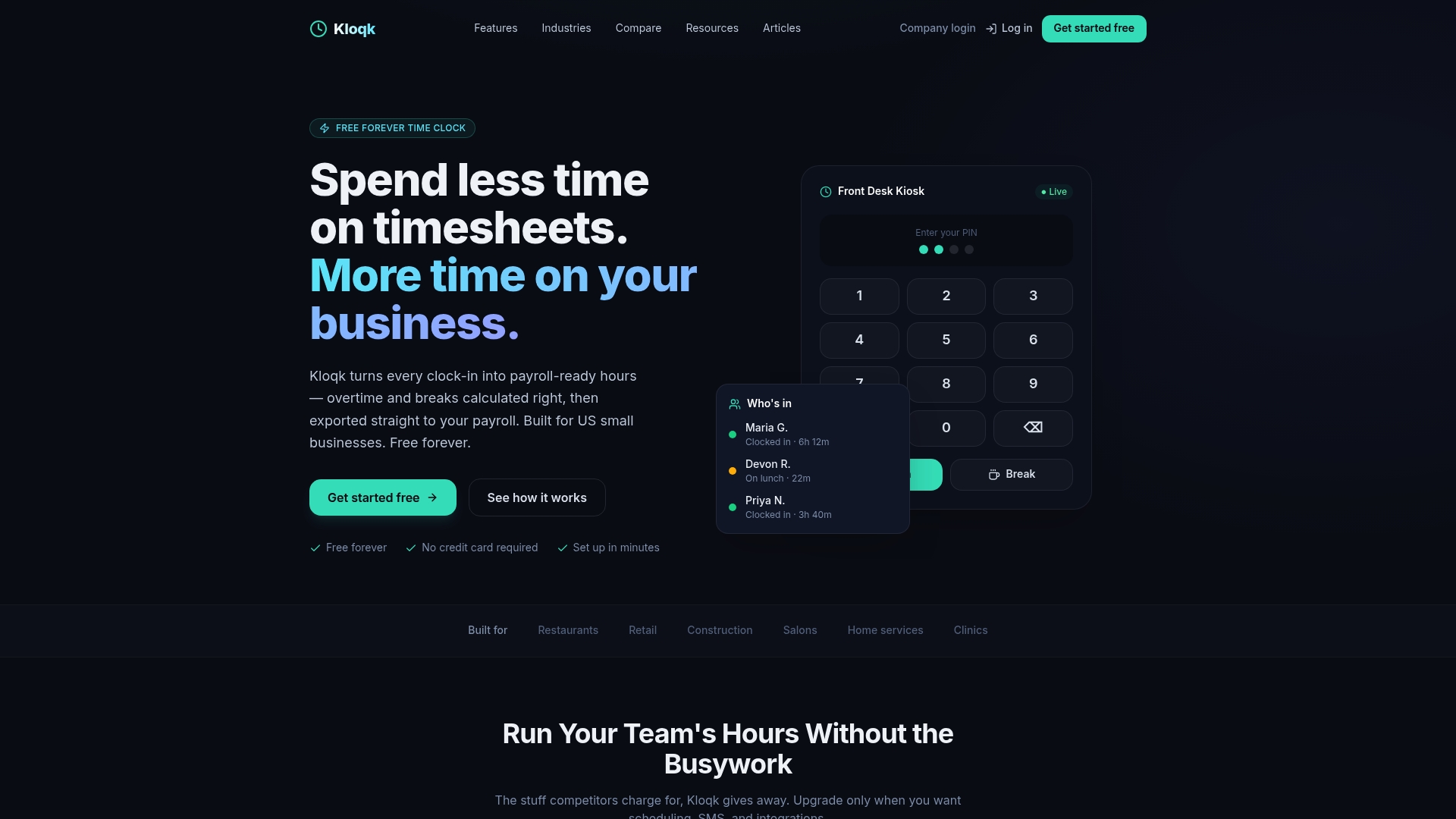
If your crews still write hours on paper or text them in, the quickest improvement is a time clock that captures every punch as it happens. The free Kloqk plan covers time clock software for small business: payroll-ready timesheets, overtime and break calculations, photo verification, payroll exports, and mobile and kiosk punching, for up to 10 people.
When you need more, Pro is $37 a month for your first 10 people, then $3.75 a person ($29 and $3 billed yearly) and Premium is $74 a month for your first 10 people, then $6.25 a person ($59 and $5 billed yearly), with advanced scheduling, time-off rules, integrations, GPS geofencing and other upgrades. Compare them on the pricing page. Franchise owners and city administrators who want a shared kiosk punch point can use the same time clock to keep every location’s hours in one place.
FAQ
Do you have to pay back payroll mistakes?
That depends on which way the mistake went. If you underpaid a worker, you owe the back wages, and interest or penalties may apply. If you overpaid, whether you can recover it from the worker depends on your state’s rules, so check with your state labor department before taking anything out of a paycheck.
What is the most common payroll mistake in construction?
Wrong overtime calculations and misclassified workers are the most frequently cited problems. Overtime errors come from mixed rates, hours spread across sites and state rules that differ from federal ones. Misclassification is the more costly of the two when it is found.
What causes payroll system failures?
Mostly bad inputs: missing punches, estimated hours, wrong rates and manual re-entry between systems. Capturing hours as they happen and exporting them directly to payroll removes most of these. Late or missed tax deposits are the other frequent cause.
Do small contractors need certified payroll?
Only if they work on covered public or federally assisted projects. On those jobs, the Department of Labor requires weekly certified payroll with a signed Statement of Compliance. Your contract or the contracting agency will say whether it applies, and some states have their own versions.
Sources
- Illegal Worker Misclassification: Payroll Fraud in the Construction Industry (DC Office of the Attorney General, 2019)
- National carpenters study on wage and tax fraud (2017)
- Top 5 Construction Payroll Mistakes and How to Fix Them
- Instructions for completing Davis-Bacon and Related Acts payroll (U.S. Department of Labor, WH-347)
- Davis-Bacon and Labor Standards: Agency/Contractor Guide
- Certified Payroll Without the Fire Drill (Construction Business Owner)
- Prevailing Wage Construction 2026: State Laws, Davis-Bacon (BuilderMuse)
- New York State Department of Labor electronic certified payroll announcement
- Payroll Errors: How to Catch, Fix, and Prevent Them (Dapt)
Recommended
Sources
Every figure on this page traces to one of these. Primary law and government sources are listed first.
Written by
Kloqk teamKloqk
Written by the people who build Kloqk's time clock, timesheets and payroll exports. Prices and laws link to the source we checked, with the date we checked it.
Keep Reading
Track Hours the Easy Way
Kloqk is a free time clock that handles punches, breaks, overtime, and payroll-ready reports.
Start free