What a Construction Project Coordinator Actually Does

A construction project coordinator keeps the paperwork, schedule, and communication running so the build doesn’t stall on something avoidable. It’s an execution-focused role: this person supports the project manager (or reports to a construction manager) rather than owning strategy or budget. On any given day, the job breaks down into three buckets:
- Document control: tracking RFIs, change orders, and permits so field crews work off current, approved drawings
- Scheduling and logistics: coordinating deliveries, subcontractor windows, and milestone deadlines
- Stakeholder communication: routing questions, writing meeting minutes, and flagging issues before they become delays
Key Takeaways
A construction project coordinator’s value comes from disciplined document control, tight scheduling coordination, and clear stakeholder communication executed daily, not occasionally.
| Point | Details |
|---|---|
| Core role definition | Coordinators execute documentation, scheduling, and communication tasks that support the project manager. |
| Top three daily duties | Document control, delivery and subcontractor scheduling, and stakeholder reporting drive the role. |
| Qualifications that matter | An associate’s or bachelor’s degree, one to five years’ experience, and OSHA 10/30 form the baseline. |
| Career acceleration path | Owning document control and subcontractor coordination speeds promotion to project manager. |
| Tools that reduce admin | Mobile field reporting and accurate timekeeping cut reconciliation work and prevent version errors. |
Table of Contents
- Construction Project Coordinator Job Description: Scope and Reporting
- Duties and Responsibilities of a Construction Coordinator
- Qualifications and Skills Needed for a Construction Coordinator
- Work Environment and Schedule for Construction Coordinators
- Tools and Software Construction Coordinators Use
- Sample Construction Project Coordinator Job Description
- How to Become a Construction Project Coordinator
- Why the Best Coordinators Get Promoted Fastest
- Frequently Asked Questions
- Sources
Construction Project Coordinator Job Description: Scope and Reporting
The coordinator sits between the field and the project manager; this is exactly where hiring managers most often get the job description wrong. This role handles operational decisions: which vendor gets called first when a delivery is late, how a redlined drawing gets logged, whether a subcontractor’s schedule change needs escalation. Strategic calls, budget authority, and client negotiations stay with the project manager or construction manager above them.
That split matters because project management specialists are described by the Bureau of Labor Statistics as owning budget, staffing, and overall project plans. A coordinator supports that work without owning it.
A few concrete examples of where the line falls:
- Coordinator decision: reordering a materials shipment when the original delivery date slips
- PM escalation: approving a change order that adds cost to the client’s contract
- Coordinator decision: updating the submittal log when an architect returns comments
- PM escalation: renegotiating a subcontractor’s scope after a design change
Pro Tip: If your job posting lists “manages client relationships” and “tracks daily RFIs” in the same bullet list, split the role. Those belong to two different jobs, and combining them sets up your new hire to fail.
Duties and Responsibilities of a Construction Coordinator
This is where the job description earns its keep. A well-written duties list should be prioritized, not just comprehensive, because coordinators juggle competing deadlines constantly. Here’s how the daily and periodic work actually breaks down:
- Document control and versioning. Maintain current RFIs, submittals, permits, and change orders so nobody on-site is working from an outdated drawing set.
- Scheduling and logistics. Coordinate material deliveries, subcontractor windows, and milestone tracking against the master schedule.
- Communication and reporting. Route RFIs to the right party, draft stakeholder updates, and take meeting minutes that actually get read.
- Site verification and quality follow-up. Track punch lists, confirm inspection results, and keep safety documentation current.
- Administrative support. Process purchase orders, track invoices, and maintain reporting templates the PM relies on for status updates.
Research from the University of South Florida’s role documentation confirms this scope: coordinators maintain daily project logs, submittal logs, and safety documentation throughout the project lifecycle, while also coordinating material deliveries and subcontractor schedules directly with field teams.
The unglamorous part of this job is also the highest-stakes part. A missed change order or an unlogged RFI doesn’t just create a paperwork gap. It creates a dispute six months later when nobody can prove who approved what, and when payment gets held up while lawyers sort it out.
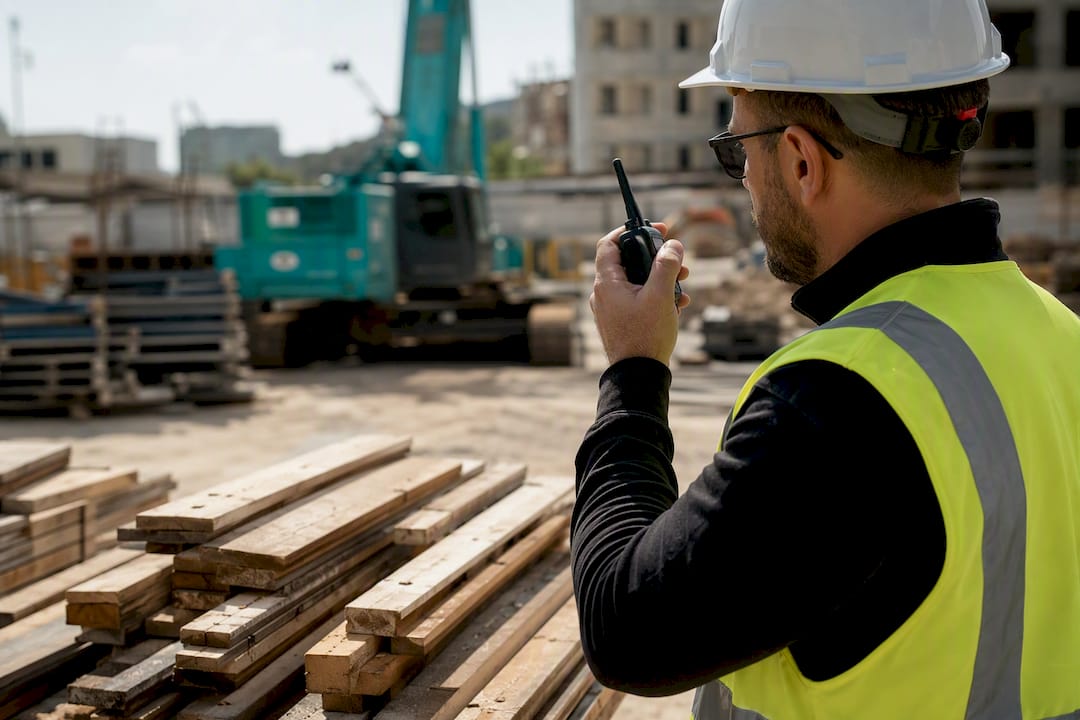
Qualifications and Skills Needed for a Construction Coordinator
Most postings ask for an associate’s or bachelor’s degree in construction management, business, or a related field, paired with some years of field or administrative experience. Fewer years plus strong software fluency often beats more years with none.
Certifications add real weight depending on career stage, such as CAPM (Certified Associate in Project Management) for entry-level coordinators, OSHA 10 or OSHA 30 training for those visiting active job sites, and PMP (Project Management Professional) or CCM (Certified Construction Manager) for coordinators aiming toward project manager roles.
On the technical side, employers want document-control system experience, scheduling tool fluency, mobile reporting comfort, and at least basic blueprint or CAD literacy. The OPM’s interpretive guidance for project manager positions outlines the competency standards many public and private employers still reference when writing qualification blocks.
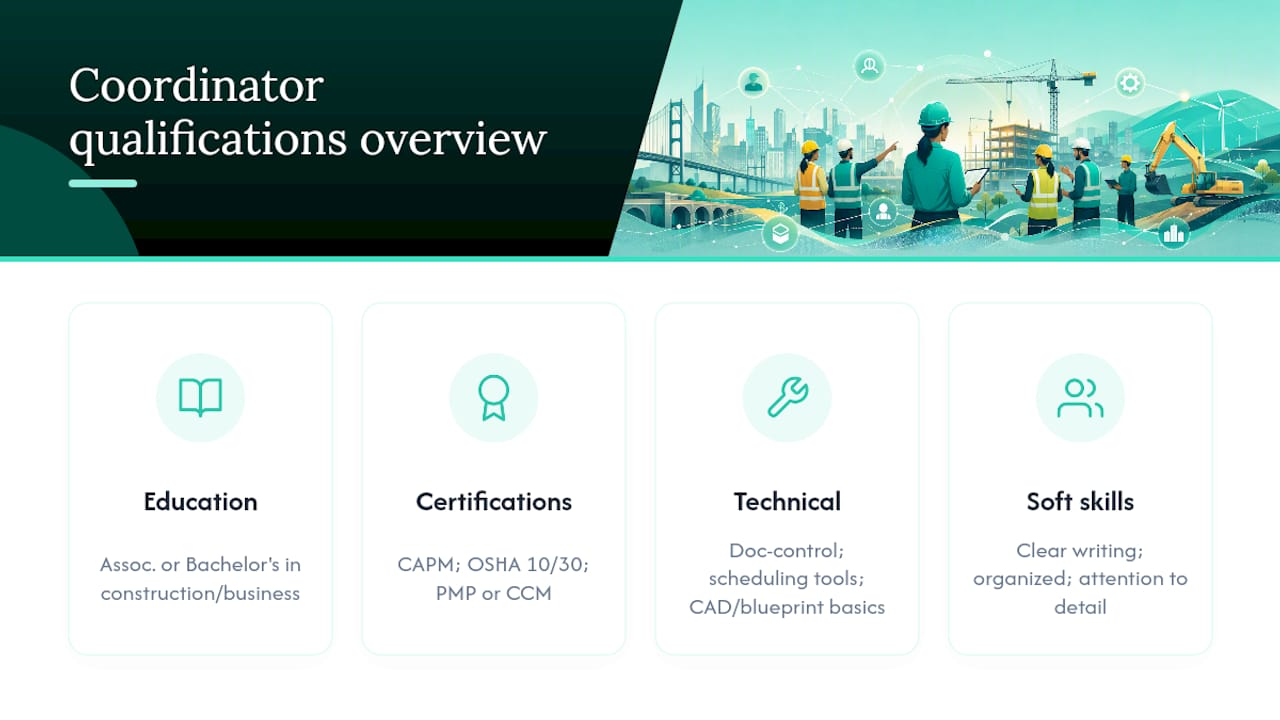
Soft skills round it out: clear written communication, obsessive organization, sharp attention to detail, and the ability to juggle five open threads without dropping one.
Work Environment and Schedule for Construction Coordinators
Expect a mix, not a fixed formula. Coordinators often split time between an office or trailer and active job sites, with site visits clustering around inspections, deliveries, and milestone walkthroughs.
- Office time handles documentation, scheduling updates, and stakeholder emails
- Site time covers verification walks, punch list checks, and subcontractor coordination
- Overtime spikes around permit deadlines, inspection windows, and phase handoffs
- On-call expectations rise on larger or multi-phase projects, where an urgent field issue can’t wait until morning
According to Indeed’s overview of the role, some coordinator positions require being reachable around the clock during active project emergencies. Anyone visiting a site needs basic PPE (hard hat, vest, steel-toe boots) as a non-negotiable minimum, not a suggestion.
Tools and Software Construction Coordinators Use
The software stack matters as much as the resume. Coordinators typically work across four tool categories, and the features inside each one determine how much rework gets avoided:
- Document control platforms with version history, so nobody builds off a superseded drawing
- Submittal and RFI tracking systems that log who asked what and when it got answered
- Scheduling software that ties subcontractor windows to the master timeline
- Field reporting and mobile timekeeping tools that capture site data and hours in real time
PlanRadar’s breakdown of the coordinator role notes that modern coordination increasingly runs through shared drives and mobile field tools rather than paper logs, which shortens the gap between a field issue and a documented fix. Mobile access and drawing markup features matter most for coordinators who split time between office and site, since a photo and a comment from the field beats a phone call relayed secondhand.
Sample Construction Project Coordinator Job Description
Job Summary: We’re hiring a construction project coordinator to manage project documentation, scheduling logistics, and stakeholder communication across active job sites. This role reports to the project manager and supports on-time, on-spec project delivery.
Key Duties:
- Maintain and route RFIs, submittals, and change orders
- Track permits and keep documentation current across all active projects
- Coordinate material deliveries and subcontractor scheduling windows
- Draft stakeholder updates and meeting minutes
- Monitor punch lists and inspection follow-up
- Process purchase orders and reconcile invoices against budget lines
- Verify field teams have current, approved drawings
- Flag schedule conflicts to the project manager before they escalate
Minimum Qualifications:
- Associate’s degree in construction management or related field (bachelor’s preferred)
- One to three years of construction administration or field experience
- OSHA 10 certification (OSHA 30 preferred)
Preferred Qualifications:
- CAPM certification
- Experience with document-control and scheduling software
Reporting and Schedule: Reports to the Project Manager. Full-time, on-site with periodic remote administrative work. Salary varies significantly by market and experience; this job-description template from Talentlyft offers a structure many employers adapt for salary and benefits language.
How to Become a Construction Project Coordinator
Most coordinators enter through a field engineer role, an administrative construction position, or a stint as an assistant project manager. That path usually runs one to three years before someone’s ready for a full coordinator title, faster with a construction management degree already in hand.
What accelerates the jump:
- Taking ownership of document control on a live project, even informally, before it’s your job title
- Volunteering for subcontractor scheduling coordination, which builds the exact skill hiring managers screen for
- Earning OSHA 10/30 and CAPM early, since both signal readiness without requiring years of tenure
- Asking for exposure to change-order processing, since that’s the duty that most directly separates a coordinator from an administrative assistant
Why Timekeeping Accuracy Matters for Coordinators
Reconciling field hours against payroll eats coordinator time that should go to documentation and scheduling. Mobile timekeeping with photo verification and GPS geofencing cuts that reconciliation work by keeping records accurate at the point of clock-in rather than after the fact. Kloqk builds these features, along with free construction time tracking, specifically for that gap. Evaluate any timekeeping tool by whether it reduces admin, not by feature count alone.
Why the Best Coordinators Get Promoted Fastest
The coordinators who move up fastest aren’t the ones with the most credentials. They’re the ones who treat document control as risk management rather than filing. A missed change order is a future dispute, not a paperwork lapse.
For hiring, skip the generic interview questions. Try three things: give a candidate a small RFI-routing scenario, hand them a redlined drawing with an intentional version mismatch and time their catch, or roleplay a scheduling conflict between two subcontractors. Watch for accuracy under pressure, not polish.
If you’re the coordinator trying to get promoted, chase subcontractor coordination experience before anything else. It’s the skill that most directly maps to a project manager title.
Frequently Asked Questions
What is the difference between a construction project coordinator and a construction project manager? A coordinator executes daily documentation, scheduling, and communication tasks. A project manager owns budget, strategy, and client relationships, and makes the calls a coordinator escalates.
Does a construction project coordinator need a degree? Most postings ask for an associate’s or bachelor’s degree in construction management or a related field, though relevant field experience combined with OSHA certification can substitute in many markets.
What certifications help a construction coordinator get promoted? CAPM and OSHA 10/30 help early on. PMP or CCM matter more once someone is targeting a project manager title.
Is the construction project coordinator role remote-friendly? Partially. Documentation and scheduling work can happen remotely with the right mobile tools, but site verification and inspections require in-person presence.
Sources
- Construction project coordinator role and responsibilities University of South Florida (document)
- What Does a Construction Project Coordinator Do? With Skills Indeed
- Project management specialists U.S. Bureau of Labor Statistics
- Interpretive guidance for project manager positions U.S. Office of Personnel Management (OPM)
- Construction Project Coordinator job description template Talentlyft
Recommended
Sources
Every figure on this page traces to one of these. Primary law and government sources are listed first.
- 1. U.S. Bureau of Labor Statisticsprimary
- 2. cloud.usf.edu
- 3. opm.gov
- 4. ca.indeed.com
- 5. planradar.com
- 6. talentlyft.com
Written by
Priya NairPeople Operations Writer
Priya focuses on HR and hiring for small teams, onboarding, scheduling people fairly, and the day-to-day of managing hourly staff without an HR department.
Keep Reading
Track Hours the Easy Way
Kloqk is a free time clock that handles punches, breaks, overtime, and payroll-ready reports.
Start free